
Review · HISTORICAL TOURS
Toulouse Food & History Tour with a Chef (in English)
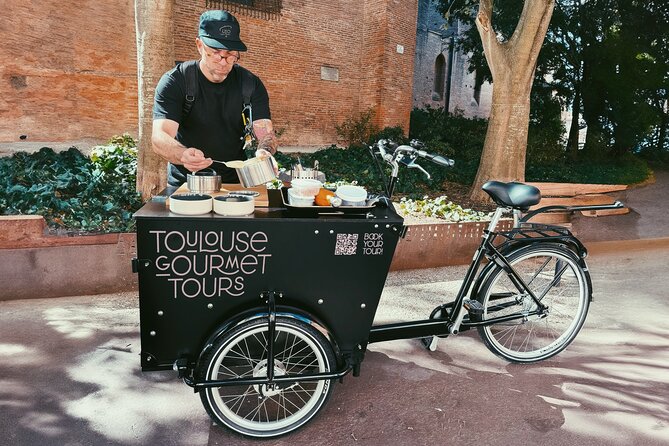
Toulouse’s best food story is told one bite at a time. Chef Alejandro, also called Alex, leads you through the center with a food cart, connecting seven tastings to the city’s architecture, politics, religion, and aviation past. It is part cooking demonstration, part history walk, and part rolling lunch.
I especially like the tight link between each dish and each place, and the fact that Alex prepares and plates food along the route rather than simply pointing you toward shops. I also like the useful follow-up advice on markets, food shops, bars, and restaurants. The main drawback is simple: you stand and walk for four hours, with no seating, so this is not the right pick if you need frequent rests.
Key points at a glance
- Seven tastings with a story: Each course connects to a Toulouse landmark or a piece of local history.
- Chef-led presentation: Alex carries a food cart and prepares or plates fresh items during the walk.
- A compact city orientation: The route covers Place du Capitole, the Garonne riverfront, Saint-Sernin, and several less obvious historic sites.
- Small-group feel: The minimum is two people, and the advertised maximum is limited, though the booking information gives both 10 and 14 as upper figures.
- Standing-only format: Wear good walking shoes and plan on eating outdoors or on your feet.
- Best timing: At 10 a.m., it works well as one of your first Toulouse activities, especially if you want food advice for later meals.
A food tour built around Toulouse’s stories
At $133.02 per person, this is not a quick market nibble. You are paying for roughly four hours with a trained chef, seven tastings, city guiding, food preparation, and a set route through central Toulouse.
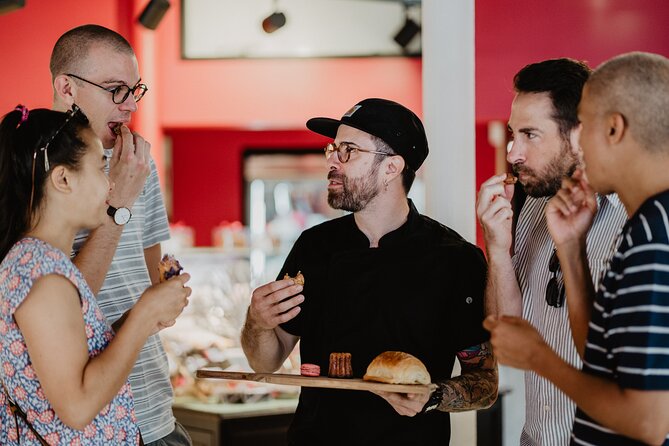
That price can make sense if you value context as much as food. Alex does not treat the tastings as random snacks. The pastry, sausage, cheese, wine, cake, and charcuterie each help explain a building, a neighborhood, a local custom, or a turning point in Toulouse’s past.
This structure also helps the tour avoid the usual food-walk problem: eating several unrelated bites and forgetting most of them by dinner. Here, the food acts as a memory aid. You may remember a building because it came with a particular pastry, or recall a political story because it was paired with Toulouse sausage.
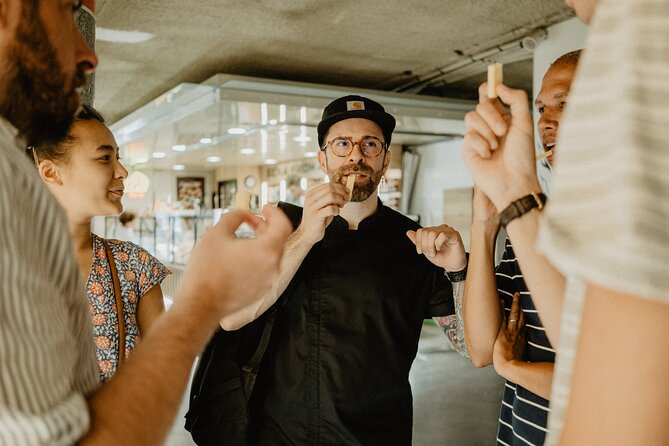
The format is also personal. Alex is described as an engaging storyteller with a strong interest in both food and local history. He uses pictures and slides during the walk, and the experience is designed as a connected story with several chapters rather than a list of dates.
More history tours in France:
- Gourmet & Cultural Tour Aix En Provence English / Espanol
★ 5.0 · 88 reviews - Avignon: Historic District Guided Food & Wine Walking Tour
★ 4.8 · 84 reviews - Bordeaux Historic and Gourmet Food Walking Tour
★ 4.5 · 82 reviews
Starting at the Hôtel d’Assézat and Fondation Bemberg
The meeting point is Georges Bemberg’s Foundation, at the Hôtel d’Assézat on Place d’Assezat. This is a strong opening because it puts you among the grand private mansions built by Toulouse’s wealthy families in the 16th century.
You learn how local fortunes paid for these impressive townhouses and why the architecture looks so different from the surrounding streets. Along the way, you taste Toulouse’s most iconic baked good. The supplied details do not name every preparation, but one account identifies the opening pastry as a chocolatine, the local term used in much of southwest France for a chocolate-filled pastry.
That first bite sets the tone. You are not just being told that Toulouse has a food culture. You are given a local item while standing in a place shaped by the money and ambition of earlier residents.
The stop lasts about 30 minutes, and admission is listed as free. You should think of the foundation mainly as an exterior and historical setting for this tour, rather than a full museum visit. If you want to explore the interior collections, allow separate time before or after.
The Garonne at Quai de la Daurade
The walk continues to Quai de la Daurade, where the river gives you a change of pace and a broad view across the Garonne. This is one of the tour’s more scenic pauses, but the story is not a gentle one.
Alex explains the great fire of Toulouse, which burned much of the city in the 15th century and changed its building methods and appearance. The fire helps explain why Toulouse’s architecture developed as it did, giving a practical reason for looking closely at materials, façades, and street patterns.
Here you receive a sweet bite from the city’s oldest pâtisserie. That pairing works well: a relaxed river view alongside a story about destruction and rebuilding, followed by something made for pleasure.
Again, the stop is about 30 minutes. There is no seating arranged for the tour, so the riverfront is a place to stand, listen, eat, and take in the view. If the weather is hot or wet, this outdoor format will matter more than it does on a mild morning.
Tour de Serta and the oldest timber frame house
At the Tour de Serta, the focus turns to one of Toulouse’s oldest surviving domestic structures. You see the oldest timber frame house in the city, dating to 1533.
This stop adds useful texture to the grand mansion story from the opening. Toulouse was not made only of wealthy homes and public monuments. Timber construction, narrow streets, and ordinary domestic buildings also tell you how the city worked.
The details here are brief, so do not expect a long architectural lecture. The value comes from seeing the structure in person and placing it within the larger development of Toulouse. It is the sort of stop you could easily pass without noticing on your own.
As with the other locations, plan for about 30 minutes. The route is designed to keep moving, so you will spend more time hearing the story and tasting the food than touring an interior.
More food tours in France:
- Bateaux Parisiens Seine River Gourmet Dinner & Sightseeing Cruise
★ 4.5 · 6,930 reviews - Authentic Parisian Gourmet Food Tour with 10 Local Dishes & Wines
★ 5.0 · 4,754 reviews - Bateaux Parisiens Seine River Gourmet Lunch & Sightseeing Cruise
★ 4.5 · 2,680 reviews - Montmartre Hill French Gourmet Food and Wine Tasting Walking Tour
★ 5.0 · 2,588 reviews
Place Saint-Georges and the Toulouse sausage course
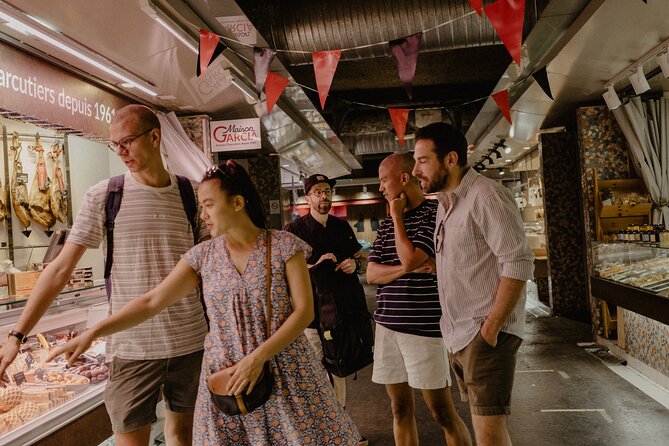
Place Saint-Georges brings a darker political story. You hear about a wrongful execution in the 18th century and how the case helped shape the country’s political future after the Revolution.
The story gives the square a human dimension. Instead of treating the French Revolution as a collection of famous names, the tour connects large political change to one person, one judgment, and one public place.
The food here is the main savory course: la véritable saucisse de Toulouse, the regional sausage for which the city is known. This is one of the most useful tastings for a first visit because it introduces a defining local product in a setting that also explains the city’s political past.
Some preparation is done before the walk, while Alex brings the food along and plates it during the route. That means you should not expect a full restaurant kitchen at every stop. The appeal is the combination of careful preparation, explanation, and place.
Marché Victor Hugo, cheese, and wine
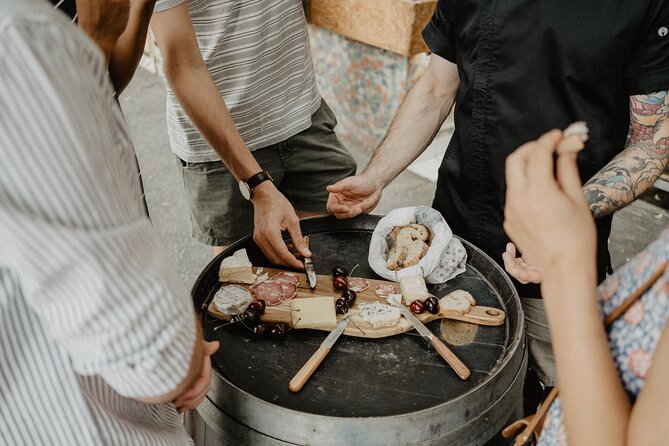
The stop at Marché Victor Hugo traces the changing use of one square. It began as a medieval rampart, later became an art nouveau market, and eventually turned into a concrete brutalist car park.
That sequence is a good reminder that cities are not fixed museum pieces. The same patch of Toulouse has served defense, commerce, and modern car traffic. It also gives you a reason to look past the market’s present function and imagine the layers underneath.
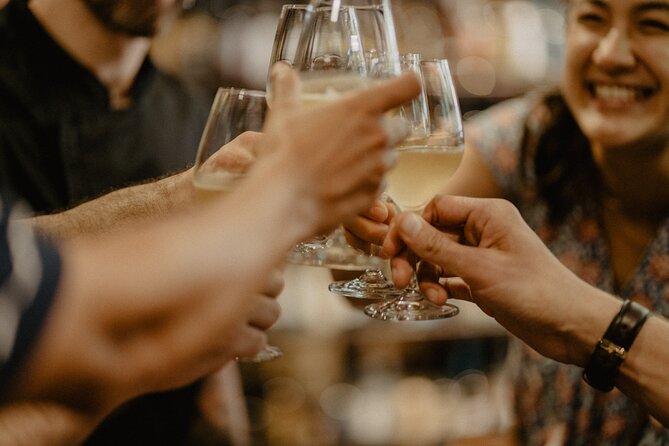
Here, the tasting shifts to a cheese and wine pairing. The selection highlights artisanal and very local products, and this is the one course specifically described as being prepared during the tour rather than simply carried in advance.
If you do not drink alcohol, tell the provider at least 24 hours ahead. The same notice applies to food allergies. This is important because the tasting menu is central to the experience, and substitutions cannot be assumed unless arranged in advance.
The market setting is also practical. If you want to return later for ingredients or a meal, this part of the route gives you an early orientation. You will not have time to turn the stop into a full market visit, so plan a separate return if you want to browse.
Saint-Sernin and a cake with an ancient recipe
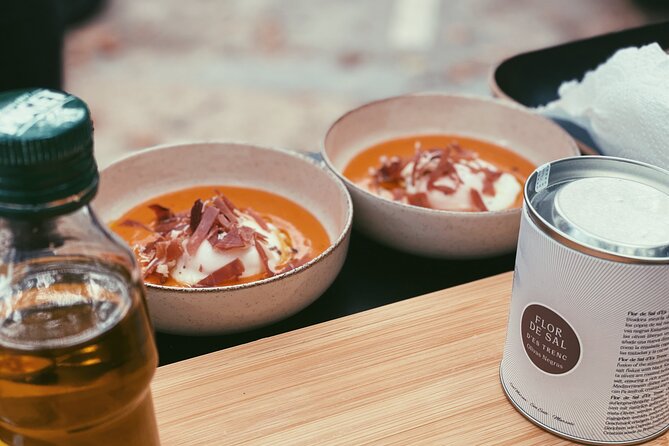
At the Basilique Saint-Sernin, the tour moves into early Christian Toulouse. You hear the story of the city’s first Christian, who opposed the Roman Empire.
The basilica is one of the most important sights on the route, and it makes a fitting setting for a story about faith, authority, and resistance. You also receive Toulouse’s most famous dessert, a cake said to follow a recipe more than 2,000 years old.
The pairing gives the final stretch a clear sense of place. You are not simply eating dessert beside a church. You are considering how ancient food traditions and religious history both remain part of the city’s identity.
Saint-Sernin is also the endpoint, so this stop functions as a finale. The experience ends five minutes on foot from Place du Capitole, giving you an easy way to continue sightseeing in the center.
Finishing at Place du Capitole with aviation and charcuterie
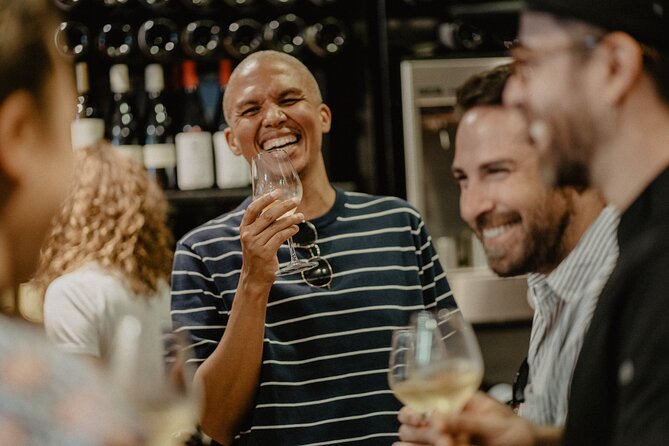
The itinerary also includes Place du Capitole, Toulouse’s grand civic square, where the subject turns to aviation. Alex explains how Toulouse became Europe’s aerospace center and why Airbus has its headquarters there.
This is a smart modern counterpoint to the older stories. After mansions, fires, timber houses, executions, medieval defenses, and early Christianity, you see how Toulouse became linked to advanced aircraft and European industry.
The final tasting is the area’s most typical charcuterie product. It keeps the food focus local while the story looks toward the modern economy.
There is a small logistical wrinkle in the supplied route description: the end point is listed as Basilique Saint-Sernin, while the tour also includes Place du Capitole and notes that the basilica is about five minutes from the square. Treat Place du Capitole as part of the final central-city section, and confirm the exact walking order with the operator if your plans depend on a precise endpoint.
What the four hours feel like
The tour begins at 10 a.m. and lasts about four hours. That makes it a substantial morning activity, not something to squeeze between breakfast and an early lunch.
The pace appears to be broken into seven main stops of about 30 minutes each, with walking between them. You should expect regular pauses for stories and food, but not long breaks. The food helps the time pass, and the accounts of the experience repeatedly emphasize that Alex keeps the group engaged with humor, pictures, personal attention, and clear links between the locations and dishes.
Still, four hours on your feet is real exercise. There is no seating during the tour. Wear comfortable shoes, avoid carrying a heavy bag, and be realistic about your stamina. The stated requirement is moderate physical fitness, and that is the right way to read it.
The experience is offered in English. It is likely to suit you best if you want a guide who can explain local food in detail while also giving you a useful first look at the city center.
How Alex’s chef format adds value
A standard food walk may take you from shop to shop, with a guide explaining what you are eating. Alex’s format is more hands-on. He carries a cart and prepares or plates food near the landmarks, so the presentation becomes part of the tour.
Several elements receive especially strong praise in the supplied comments: the quality of the food, the way each tasting fits its historical setting, Alex’s storytelling, and the practical advice he sends afterward. He has also been described as speaking several languages, though the tour itself is offered in English.
You should understand the food service clearly. This is not seven restaurant courses served at tables. Most of the food is prepared ahead and brought along, then plated during the walk. The cheese and wine pairing is prepared on the route. That approach keeps the group moving, but it also means portions and presentation are suited to a walking tour.
The follow-up help can be valuable. Alex provides notes, photographs, and suggestions for markets, food shops, bars, and restaurants. If you take the tour early in your stay, you have time to use that information.
Group size, weather, and practical limits
The experience requires at least two people to operate. The information gives two different maximum group figures, 10 and 14, so confirm the current limit before booking if group size matters to you.
A small group should make it easier to hear stories, ask questions, and watch the food being plated. A larger group may feel less personal, especially during explanations at busy public sites.
The tour depends on good weather. If poor weather causes cancellation, you are offered another date or a full refund. You can also cancel for a full refund up to 24 hours before the start time. Cancellations or changes inside that window are not refunded or accepted.
Service animals are allowed, and the route is near public transportation. No special museum admission is included in the stated stop details, and each attraction is listed with free admission for the tour.
Who should book this Toulouse tour
I would choose this experience if you want three things in one morning: a central Toulouse orientation, a serious introduction to regional food, and stories that help the city make sense.
It suits couples, families with older children, solo visitors who enjoy small-group activities, and anyone who likes to learn through eating. It is also a smart first-day activity because the food advice can shape the rest of your stay.
You may want something else if you prefer long restaurant meals, indoor seating, a faster sightseeing pace, or a tour focused only on architecture. The standing-only format is the main limitation, and the $133.02 price will feel high if you mainly want a few samples.
Should you book it?
Book this Toulouse food and history tour if you want the city explained through local dishes rather than through a string of dates. Alex’s strongest contribution is the connection between place, story, and food: the pastry at a mansion, the sweet at the river, sausage at a historic square, cheese and wine at the market, and regional specialties near the city’s major monuments.
I would book it near the start of your stay, tell the operator about allergies or alcohol preferences at least 24 hours ahead, and arrive ready to walk and stand. If you value personal guiding, thoughtful food presentation, and practical restaurant advice, the cost is reasonable for four hours. If you need a seated meal or frequent rest stops, choose a shorter food activity instead.
FAQ
Where does the Toulouse food and history tour start?
It starts at Georges Bemberg’s Foundation, the Hôtel d’Assézat, on Place d’Assezat in central Toulouse.
Where does the tour end?
The stated endpoint is Basilique Saint-Sernin de Toulouse. It is about a five-minute walk from Place du Capitole.
What time does the tour start?
The tour starts at 10:00 a.m.
How long does the experience last?
The walking tour lasts approximately four hours.
Is the tour offered in English?
Yes. English is the listed language for the experience.
How many tastings are included?
The route includes seven tastings, with sweet and savory items such as pastry, a Toulouse sausage course, cheese and wine, cake, and charcuterie.
Is there seating during the tour?
No. You eat on your feet and should be prepared to stand and walk for the full experience.
Can I cancel for a full refund?
Yes, if you cancel at least 24 hours before the scheduled start time. Cancellations within 24 hours are not refunded.
New food tours we have reviewed in France
- Taste Cannes – A Full French Riviera Food Tour by Do Eat Better★ 5.0 · 63 reviews
- Cannes Ooh La La Croissant Tasting Tour★ 5.0 · 30 reviews
- Saint-Émilion day tour: village visit, Châteaux and lunch★ 5.0 · 121 reviews
- Bordeaux wines tasting workshop including Food & Wine pairings★ 5.0 · 31 reviews
- NO DIET CLUB – Unique food tour in Bordeaux !★ 5.0 · 201 reviews
- Historical Center, Bordeaux Food Tour★ 5.0 · 33 reviews
- Bordeaux Food and Wine Tour : Authentic Artisanal Flavors★ 5.0 · 62 reviews
- Bordeaux Gourmet Experience : tasting of French cheeses & wines★ 4.5 · 71 reviews
Historical Tours, compared.
Barcelona: Tapas Walking Tour with Food, Wine, and History
Read our review →
Sevilla Food Tour: Tapas, Wine, History & Traditions
Read our review →
Madrid Tapas & Taverns Small Group Food & History Tour
Read our review →
Barcelona Tapas Walking Tour: Food, Wine & History
Read our review →
Boston Food & History: Pizza, North End & Freedom Trail
Read our review →Browse the lists this tour appears in