
Review · CHINATOWN FOOD TOURS
Flavors of Bangkok: Small-Group Chinatown Evening Food Tour
Bangkok’s Chinatown is best understood one bite at a time. This evening walk takes you through narrow lanes and along Yaowarat Road, stopping at several food stalls, restaurants, markets, and small shops for dishes such as dim sum, dumplings, peppered pork noodles, fried oyster omelets, duck, sticky rice with mango, and sweet drinks. The food is the main event, but the street scenes and Thai-Chinese stories give the meal a sense of place.
I like two things right away: the maximum of 10 people, which makes it easier to ask questions and keep pace, and the mix of venues. You are not simply seated at one restaurant. You move through the neighborhood, trying small portions in places you might not locate on your own. Guides such as Bella, Katy, Jung, Joker, Ohm, and Thee have all been praised for making the route friendly and informative.
The main caution is dietary. Gluten-free, halal, vegan, and vegetarian diets cannot officially be accommodated, even though one vegetarian participant reported that a guide made useful adjustments. You should also arrive hungry, wear good walking shoes, and expect a full evening on your feet.
Key points at a glance
- Start at Wat Mangkon MRT at 5:30 pm: The meeting point puts you close to the heart of Chinatown and makes the tour practical by public transport.
- Try many small portions: The route can include pork pepper soup, noodles, dim sum, dumplings, oysters, duck, pastries, coconut drinks, and mango sticky rice.
- Walk through Yaowarat after dark: The route mixes food with market lanes, Chinese shops, street activity, and the large red Chinese architectural gate.
- Learn how Thai and Chinese food meet: Your guide explains the Chinese community’s more than two centuries in Bangkok and the neighborhood’s food traditions.
- Groups stay small: Up to 10 people means more room for questions and more flexibility when the group starts feeling full.
- Plan around the limitations: Hotel transfers are not included, strollers are not allowed, and special diets are restricted.
Why Bangkok Chinatown works so well after sunset
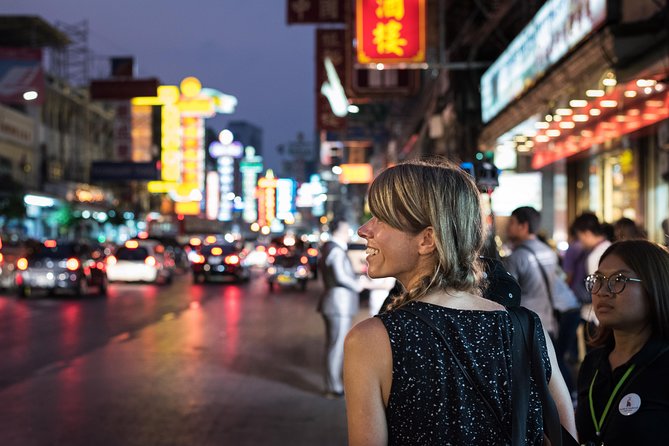
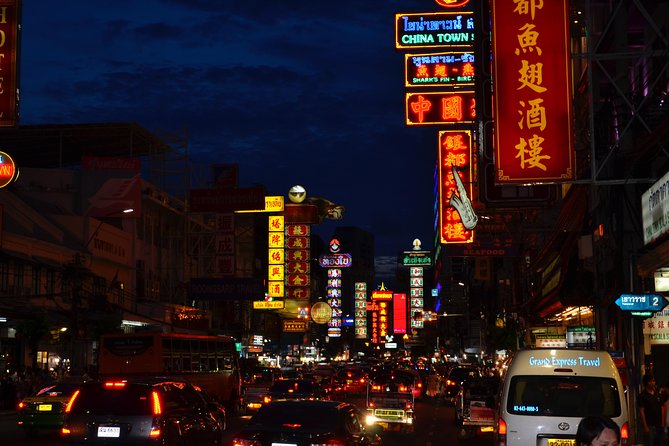
Bangkok’s Chinatown is not a museum district. It is a working neighborhood of food sellers, old shops, restaurants, markets, and narrow lanes. At night, the area becomes a moving feast of smells, signs, cooking sounds, and people stopping for dinner.
That setting matters. You are not only eating Thai-Chinese dishes; you are seeing where the food belongs. A bowl of noodles makes more sense when you have just passed a small shop selling Chinese ingredients, and a sweet coconut drink feels different when it arrives during a walk through crowded Yaowarat.
The neighborhood has served as a center of Bangkok’s Thai-Chinese community for more than 200 years. Your guide gives you enough background to understand the area without turning the evening into a lecture. The best guides, including Bella, Katy, Jung, Joker, Ohm, and Thee, have been praised for mixing history with easy conversation and practical food advice.
The tour is especially useful if this is your first visit to Chinatown. The streets can feel confusing, with food counters tucked beside shops and small restaurants hidden in lanes. A local guide removes much of the guesswork and helps you spend your limited evening on eating rather than deciding where to stop.
More Evening Food Tours in Bangkok
- Bangkok Tuk-Tuk Tour by Night with Chinatown Street Food Meal
★ 5.0 · 635 reviews - Bangkok by Night Food Tour with 10+ Tastings in Chinatown
★ 5.0 · 545 reviews - Bangkok: E-Scooter Night Tour with Local Street Food
★ 4.8 · 488 reviews
Meeting at Wat Mangkon MRT
The evening begins at Wat Mangkon MRT station at 5:30 pm. The address given for the meeting and ending point is 530 Charoen Krung Road in Samphanthawong. This is a sensible start because the station is near Yaowarat Road and is easy to reach by Bangkok’s public transportation system.
The tour description also places the beginning near Hua Lamphong, at the edge of Chinatown. In practice, use the confirmed Wat Mangkon meeting point and arrive early enough to find your guide. The tour ends back at Wat Mangkon, so you do not need to arrange a complicated pickup from an unknown street.
Hotel pickup and drop-off are not included. That is not a major problem for most people, but it means you should allow time to reach the station and find your way back afterward. The guide can help with directions at the end.
The first Chinatown food stops
The opening part of the walk takes you through the Chinese community around Wat Mangkon. You can expect two or three Thai-Chinese tastings during this section, with both savory and sweet food included.
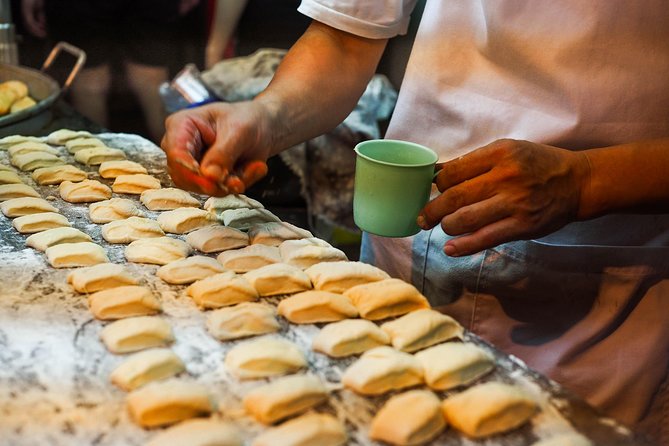
The exact dishes change. Depending on the day, you might find dim sum, dumplings, peppered pork noodles, coconut drinks, pastries, or another local specialty. Some food stops are in small restaurants, while others may be at stalls or shops. This variation is useful because Thai-Chinese food is not one fixed menu. It can include noodle soups, steamed bites, fried snacks, roast meats, sweets, and drinks shaped by both Chinese and Thai cooking traditions.
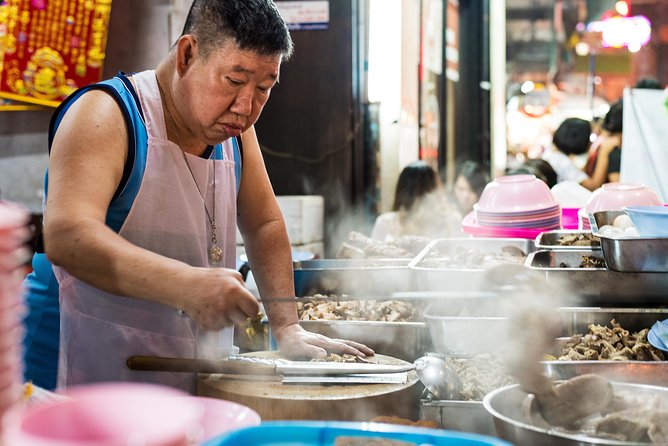
Several food combinations have received especially strong praise. Pepper soup and peppered pork noodles are recurring highlights, while fried oyster omelets offer a rich, crisp contrast. Other possible tastes include pork neck with chili salad, duck, chicken, oysters, rice, tofu, hot ginger drinks, and sticky rice with mango.
You should not expect a formal tasting menu with a printed sequence. This is a street food walk, and the guide may adjust the stops according to what is open, seasonal, available, or suitable for the group. Venues and dishes can be replaced without notice when circumstances require it.
That flexibility is part of the experience, though it can also create uncertainty. If you want one famous dish at one exact restaurant, this is not the right format. If you prefer to sample several kinds of food and let the guide choose the best available stops, it works much better.
The red Chinese gate and the walk toward Yaowarat Road
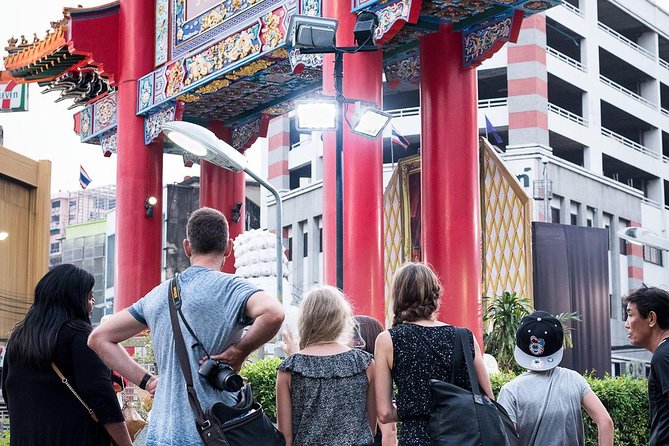
One stop highlights the large red Chinese architectural gate on the Mittaphap Thai-China roads. It gives the walk a visual landmark and a useful pause between food stops. Your guide can place the neighborhood’s Chinese identity in context while you take in the architecture and surrounding streets.
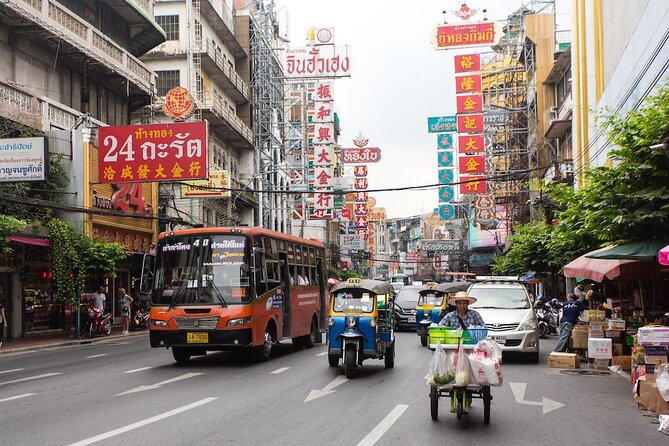
From there, the route continues toward Yaowarat Road. This is the main public face of Bangkok Chinatown, lined with restaurants, food vendors, shops, signs, and passing traffic. You will walk rather than ride, so the neighborhood unfolds at street level.
The route is described as leisurely, but do not confuse that with effortless. You may be standing while eating, squeezing through busy lanes, and walking between several stops. One guide gave rain gear to the group during a wet evening, but you should still check the forecast and bring suitable protection. The tour continues through ordinary city conditions rather than an enclosed dining room.
Yaowarat is where the tour’s different parts come together. You see the food, smell it cooking, learn where the Chinese community established itself, and watch the evening meal take shape around you. It is a better introduction to Chinatown than simply arriving at one restaurant and leaving again.
More Evening Food Tours in Thailand
- Bangkok Tuk-Tuk by Night with Chinatown Street Food Meal
★ 4.6 · 263 reviews - Bangkok Food Tour By Night
★ 5.0 · 241 reviews - Bangkok Tuk Tuk Food Tour By Night
★ 5.0 · 198 reviews - Bangkok Evening Food Tour by Tuktuk
★ 5.0 · 86 reviews
Eating your way along Yaowarat Road
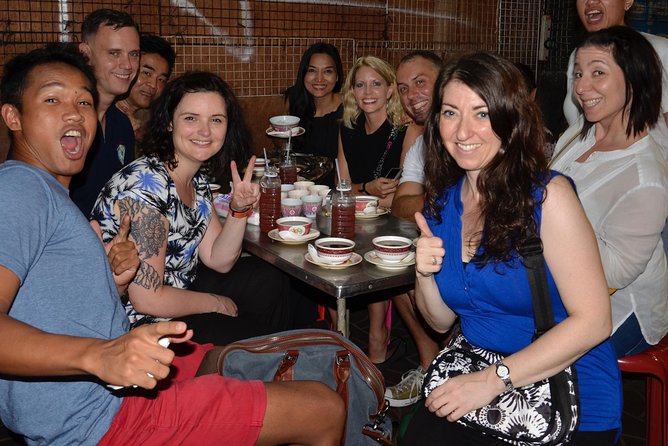
The Yaowarat section lasts roughly an hour and a half in the stated itinerary, with more Thai-Chinese tastings along the way. The full experience lasts about four hours, so expect additional walking, conversation, and stops beyond the two main itinerary blocks.
The amount of food can be substantial. Several people have described finishing the tour completely full, with one group tasting seven or eight different restaurants or food stops. Portions are designed for sampling, but the total adds up quickly.
Come hungry, but pace yourself. It is easy to eat too much during the first few stops and then struggle with the later specialties. Tell your guide early if you dislike a particular ingredient or need to slow down. Guides have adjusted the route or selections for group preferences, especially when the group wanted something lighter near the end.
This is also a good setting for trying something unfamiliar. Tofu, pork neck, ginger drinks, oysters, duck, and Chinese-style pastries may not all be part of your usual Bangkok meal. You are not required to like every dish, but the small portions make experimentation less risky.
The food is not necessarily what you might expect from a standard Chinese restaurant outside Thailand. Thai ingredients, local seasoning, street-food methods, and Chinese traditions meet here. If you arrive expecting only familiar dumplings and fried rice, you may be surprised. If you are open to dishes that sit between Thai and Chinese cooking, you will get more from the evening.
The guide makes the difference
A small-group food walk depends heavily on the guide. The best version of this tour is not just a list of dishes. It is a moving conversation about why the food is sold in a particular place, how the neighborhood developed, and what to notice as you walk.
Bella has been praised for combining humor, local history, photographs, and food recommendations. Katy has been singled out for helping match dishes to personal tastes. Jung has received strong feedback for keeping the group comfortable and engaged, while Joker has been described as a good fit for showing first-time visitors through Chinatown’s maze.
Ohm, Thee, Jah, Pax, Woody, and other guides may lead the tour depending on the date. You should not book on the assumption that one particular person will be assigned to you. The important point is that the experience can change with the guide, so the guide’s ability to manage food preferences and group pace matters as much as the menu.
There has been at least one less polished experience involving last-minute hosts who seemed uncertain about the route and food arrangements. That is worth keeping in mind. Most of the available feedback is strongly positive, with a 4.8 rating and 96 percent recommending the experience, but no guided walk is identical every evening.
Is the $104.28 price fair?
At $104.28 per person, this is not a cheap street-food crawl. You could eat some individual Chinatown dishes for far less. The price has to cover more than the food itself: a four-hour guided walk, multiple tastings, beverages, local interpretation, and the convenience of having someone choose and connect the stops.
The value improves if you are short on time or uneasy about navigating Chinatown at night. You get a broad sample of the district without spending half the evening comparing menus or guessing which stall is worth trying. The small group also gives you a better chance to ask questions than a large coach tour would.
The value is weaker if you already know Yaowarat well, prefer to order only what you choose, or want a restaurant-focused meal. You may also feel the price is high if dietary restrictions prevent you from eating much of the included food.
Group discounts may be available, and the mobile ticket makes the booking simple. Free cancellation is available up to 24 hours before the start time. Within 24 hours, changes and refunds are not accepted.
Who should book this evening walk?
I would recommend it to first-time visitors who want an organized introduction to Chinatown and to returning visitors who have seen Bangkok’s major sights but have not explored this district through food.
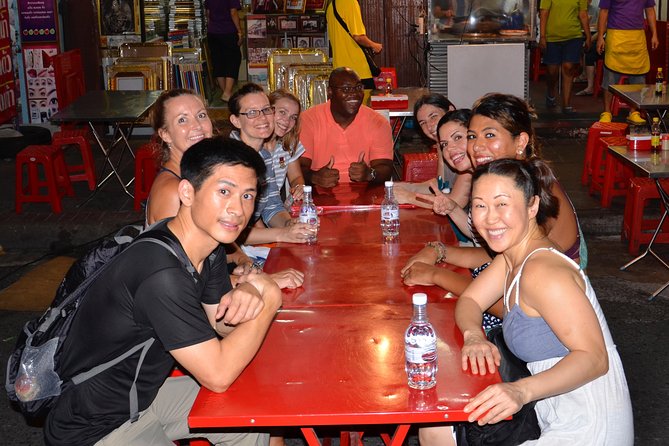
It suits couples, friends, families with children aged six and older, and solo visitors who like meeting a small group. The maximum group size is 10, though a smaller booking can feel almost private. One couple happened to be the only booking on their evening and received a private walk with Bella.
You need to be comfortable walking for several hours and eating in changing settings. Comfortable shoes are important. Strollers are not allowed, which makes the tour less practical for families with very young children.
This is not a good choice for strict vegetarians, vegans, people requiring halal or gluten-free food, or anyone with serious dietary limits. You can state dietary requirements when booking, but the official conditions say those diets cannot be accommodated. If you have a mild preference rather than a strict restriction, discuss it with the guide at the start, but do not count on a full alternative menu.
Should you book Flavors of Bangkok?
Book this tour if you want Chinatown explained through its food, prefer several small tastings to one large dinner, and value a local guide who can lead you through lanes you might skip alone. The strongest features are the small group, the number of stops, the mix of savory and sweet food, and the chance to see Yaowarat after dark.
Skip it if you need a controlled menu, dislike walking, or want to keep your food spending low. For everyone else, this is a useful four-hour introduction to Bangkok’s Thai-Chinese food culture, with enough variety to make the price easier to justify. Arrive hungry, wear shoes made for walking, and leave room for dessert.
FAQ
Where does the Bangkok Chinatown food tour start?
The tour starts at Wat Mangkon MRT station, at 530 Charoen Krung Road in Samphanthawong. The stated start time is 5:30 pm.
Where does the tour end?
The tour ends at Wat Mangkon, the same location listed for the meeting point. The guide can help with directions to your next destination.
How long does the experience last?
The tour lasts approximately four hours.
How many people can join the tour?
The group is capped at 10 participants.
What food might be included?
Possible tastings include dim sum, dumplings, peppered pork noodles, coconut drinks, fried oyster omelets, pork, chicken, oysters, duck, rice, pastries, hot ginger drinks, and sticky rice with mango. Dishes and venues can change.
Can the tour accommodate vegetarian, vegan, halal, or gluten-free diets?
No. The tour information states that gluten-free, halal, vegan, and vegetarian diets cannot currently be accommodated. You should provide dietary requirements when booking.
Is hotel pickup included?
No. Hotel pickup and drop-off are not included. The tour is near public transportation, and the meeting point is at Wat Mangkon MRT station.
More after-dark experiences in Bangkok
- Night Street Food Tour of Bangkok’s Chinatown
★ 5.0 · 173 reviews - Bangkok Night Food Tour By Tuk Tuk
★ 5.0 · 75 reviews - Bangkok: Street Food Tasting Tour at Night
★ 4.4 · 48 reviews - Bangkok: Highlights with Food Tour & Sunset in Wat Arun
★ 4.9 · 28 reviews
More Chinatown food tours in Bangkok
- Bangkok Authentic Tasting Thai-Chinatown Walking Food Tour
★ 4.9 · 852 reviews - Bangkok: Tuk Tuk Adventure Chinatown Michelin Food & Temples
★ 4.3 · 725 reviews - Bangkok: Chinatown Food Tour with Michelin Food Stalls
★ 4.8 · 226 reviews - Bangkok Night Michelin Foodie Tour in Chinatown with 15+ tastings
★ 5.0 · 189 reviews
New food tours we have reviewed in Bangkok
- Bangkok 3-in-1 Tour: Longtail Boat,TukTuk & Street Food Adventure★ 5.0 · 73 reviews
- 4-Hour Hidden Bangkok TukTuk Street Food Guided Tour★ 5.0 · 23 reviews
- Private Tuktuk Authentic Food Tour (Chinatown-Flower Market)★ 5.0 · 75 reviews
- Train & Floating Market Food Adventure + Scenic train ride★ 5.0 · 102 reviews
- Bangkok Tuk Tuk Food Tour By Night★ 5.0 · 198 reviews
- Timeless Thonburi Canal and Food Tour★ 5.0 · 31 reviews
- Authentic Street Food Tour in China Town Bangkok★ 5.0 · 25 reviews
- Night Street Food Tour of Bangkok’s Chinatown★ 5.0 · 173 reviews
Chinatown Food Tours, compared.
NYC: Chinatown & Little Italy Food Tour with 7 Flavorful Tastings
Read our review →
Original NYC Guided Food Tour of Chinatown and Little Italy
Read our review →
Chinatown & North BeachLittle Italy: 7 Tastings & History
Read our review →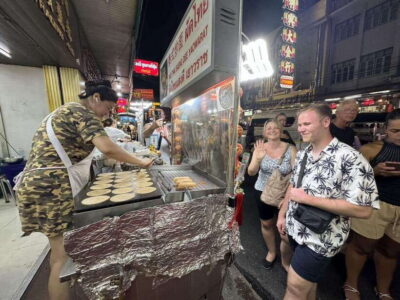
Bangkok Authentic Tasting Thai-Chinatown Walking Food Tour
Read our review →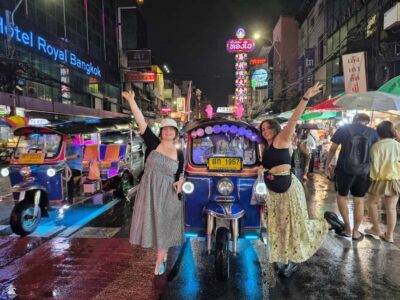
Bangkok: Tuk Tuk Adventure Chinatown Michelin Food & Temples
Read our review →

Bangkok Tuk-Tuk Tour by Night with Chinatown Street Food Meal
Read our review →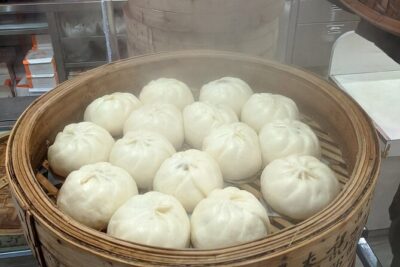
A Wok Around Chinatown: Culinary and Cultural Walking Tour Led by a Chef
Read our review →Browse the lists this tour appears in