Review · TOURS
Arequipa Tasting Tour
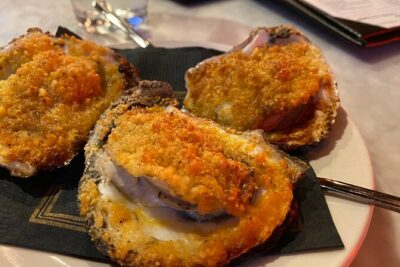
Arequipa’s best first introduction may be found not in a single church or museum, but in the short walk between them. This tour links the city’s plazas, white-stone religious buildings, San Camilo Market, and a final tasting of queso helado and pisco. Guides such as José, Daniel, and Jorge bring plenty of local detail, from earthquake damage to alpaca wool and food traditions.
I like the small maximum of eight people, which makes it easier to ask questions and follow your guide through the market. I also like the price: at $13, the tour gives you a walking orientation, market visits, local fruit, dessert, and pisco without requiring a full-day commitment. The main caution is simple: despite its name, this is mostly a history and architecture walk, with the tasting saved for the end.
Key points to know before booking
- San Camilo Market is the food highlight: You can see regional tubers, fruit, meats, and other everyday ingredients, with tastings arranged along the way.
- The tasting comes late: Queso helado and pisco are served at or near the end at Centro Artesanal Fundo el Fierro.
- The walking route is history-heavy: Expect stories about Arequipa’s founding, earthquakes, churches, Jesuit buildings, and changing city life.
- The group is capped at eight: That is a useful size for market access and questions without the feel of a large tour.
- You finish near Plaza San Francisco: The endpoint is practical for continuing into the artisan center or returning toward the historic center.
- Plan lunch before an afternoon departure: Lunch is not included, and the operator recommends eating beforehand.
A food tour that begins with Arequipa’s past
The Arequipa Tasting Tour is best understood as a compact city walk with a food finish. Its route crosses the historic center, beginning at Plaza de Armas and ending at Centro Artesanal Fundo el Fierro near Plaza San Francisco.
That structure matters. You do not simply arrive at a market, eat a few samples, and leave. You first learn why the city looks the way it does, how earthquakes shaped its buildings, and why religious architecture occupies so much of the center. By the time you taste pisco and queso helado, the food has a clearer setting.
The tour lasts about three hours and thirty minutes. The listed stops account for roughly two hours and fifteen minutes, so the remaining time is used for walking, explanations, transitions, and tastings. Wear comfortable shoes and expect a steady city walk rather than a seated culinary class.
The group limit of eight is one of the strongest practical features. A guide can answer individual questions, pause at a market stall, and keep the pace flexible. Several guides have received warm praise for taking time with questions, especially José and Daniel. Jorge has also led the route in Spanish. Guide assignments can vary, so book this for the itinerary and format rather than a guaranteed named guide.
More food tours in the world:
- Reykjavik Food Walk – Local Foodie Adventure in Iceland
★ 5.0 · 18,952 reviews - Dubai: Old Town, Creek, Museums, Souks, & Street Food Tour
★ 4.8 · 10,816 reviews - Ho Chi Minh City Street Food Tour & Sightseeing By Motorbike
★ 5.0 · 9,413 reviews
Plaza Campo Redondo and Arequipa’s first settlement
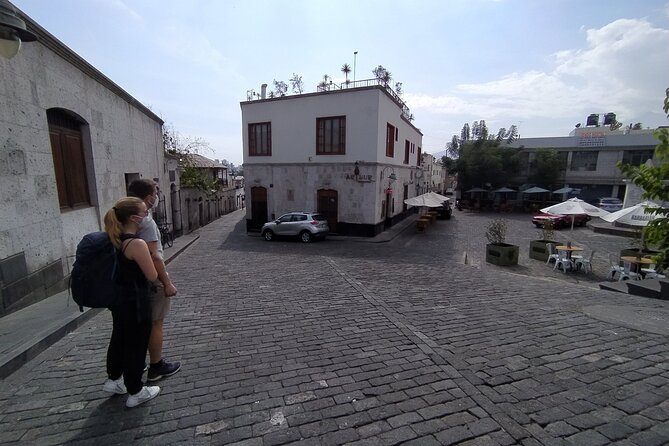
The opening stop is Plaza Campo Redondo, in one of Arequipa’s traditional neighborhoods. It is described as the first place where Spanish conquerors settled after arriving in the area.
You spend only about 10 minutes here, but that short pause gives the tour a useful starting point. Instead of treating Arequipa as a polished colonial center that appeared all at once, your guide places it within the city’s early settlement story. This is a good moment to ask how the city grew from its first colonial foothold into the large regional center you see today.
There is no admission charge. The stop is brief, so do not expect a long formal visit or a major interior attraction. Its value is context. It helps you see the rest of the route as part of a city that changed over centuries, not as a collection of unrelated monuments.
San Francisco Plaza, Santa Catalina, and Fundo el Fierro
From Campo Redondo, the walk passes by the Santa Catalina Convent and the street carrying its name before reaching San Francisco Plaza. The route does not list a full convent visit, so you should not book this tour expecting entry into Santa Catalina. You get an exterior look and a chance to hear how the area fits into Arequipa’s historic center.
San Francisco Plaza is home to the imposing Church and Monastery of San Francisco. Your guide discusses the building and the nearby Fundo el Fierro artisan center, which also becomes important at the end of the tour.
This stop lasts about 20 minutes and does not include an admission ticket. That keeps the tour inexpensive, but it also means the emphasis is on streets, façades, and explanation rather than extended museum time. I like this approach for a first afternoon in Arequipa. You get your bearings quickly, then can return later to any place that deserves a slower visit.
Plaza de Armas and the city shaped by earthquakes
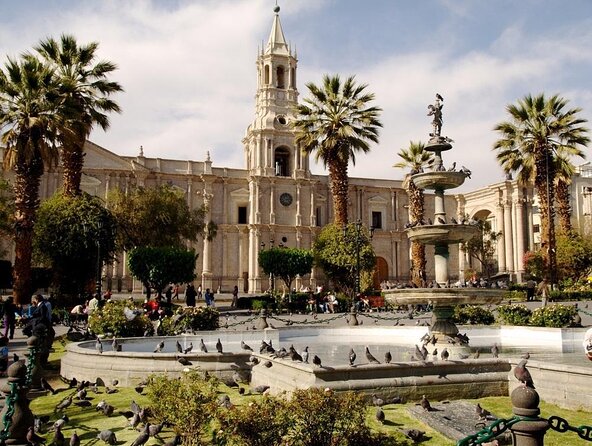
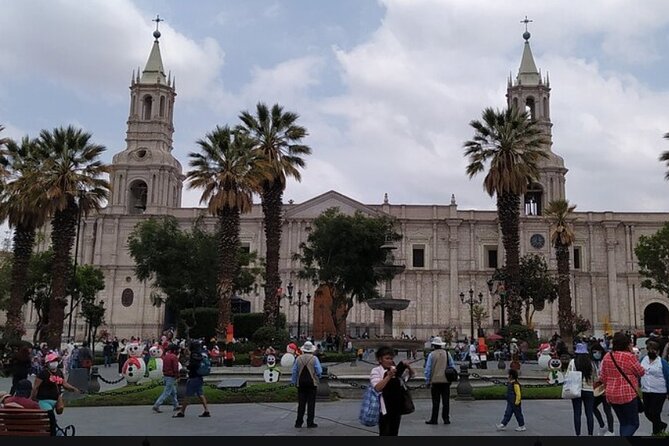
The main meeting point is Plaza de Armas, where the tour formally gathers before continuing. This is the visual center of Arequipa, and the guide uses it to explain the city’s founding, later changes, the Cathedral, and the effects of repeated earthquakes.
Allow about 25 minutes here. That may sound short for such an important square, but a focused explanation is more useful than a long list of dates. Ask your guide to point out signs of rebuilding and changes in the surrounding buildings. The square works as an open-air lesson in how Arequipa has had to balance colonial form with seismic reality.
This is also where the tour’s historical focus becomes clear. If you want food tastings every few minutes, the route may feel slow. If you like understanding what you are looking at before you take photographs, the stop earns its place.
The plaza is also the easiest starting point to reach. The official meeting location is Plaza de Armas, Arequipa 04001. Since the tour starts in the city center, you do not need a separate transfer arranged through the operator.
Same appetite, a different neighbourhood:
- Montserrat Half-Day Tour with Tapas and Gourmet Wines
★ 5.0 · 7,359 reviews - Dubai: Old Town, Souks, Street Food, Guided Tour & Abra Ride
★ 4.9 · 7,170 reviews - Bateaux Parisiens Seine River Gourmet Dinner & Sightseeing Cruise
★ 4.5 · 6,930 reviews - Tokyo: Shinjuku Food Tour (13 Dishes at 4 Local Eateries)
★ 5.0 · 6,603 reviews
The Church of the Company of Jesus
A short walk brings you to the Church of the Company of Jesus, on one side of Plaza de Armas. The complex includes the church and cloisters, with the church known for its baroque façade, restrained interior, and altars covered in gold leaf.
The scheduled visit is about 10 minutes. That is enough for an explanation and a look, but not enough for a patient architectural study. The building is an important reminder that Arequipa’s religious spaces are not all alike. The outside can be highly decorated, while the interior feels more controlled and quiet.
Admission is not included, and the supplied tour details do not give an entrance fee. That means you should treat the stop as a guided exterior and orientation visit unless your guide confirms that a particular area is open and included. The tour works best for people who want a clear introduction, then plan their own return visit if a church or cloister catches their interest.
San Camilo Market is where the route comes alive
The 30-minute stop at San Camilo Market is likely the most memorable part for anyone interested in daily food culture. It is described as one of Peru’s most varied markets, with regional tubers, meats, fruits, and other products sold for local use.
This is not a polished tasting hall. You are seeing the ingredients that support ordinary cooking in Arequipa. That makes the market valuable even if you are not especially adventurous with food. You can look at the range of produce, ask how items are used, and see how the region’s agriculture appears in a working market.
The guide may lead you to several food stands and offer samples of fruit or other local products. The exact tasting selection can vary, so approach it as a chance to try what is available rather than a fixed menu. This is also the part of the tour where a small group helps most. Eight people can gather around a stall far more easily than a large coach group.
San Camilo is a good place to ask about food names and preparation. It also gives you practical ideas for later meals. Just remember that the tour does not include lunch, bottled water, or soda. If you take the tour in the afternoon, eat beforehand. The market stop is for tasting and observation, not a meal replacement.
The Jesuit cloisters and the final tasting
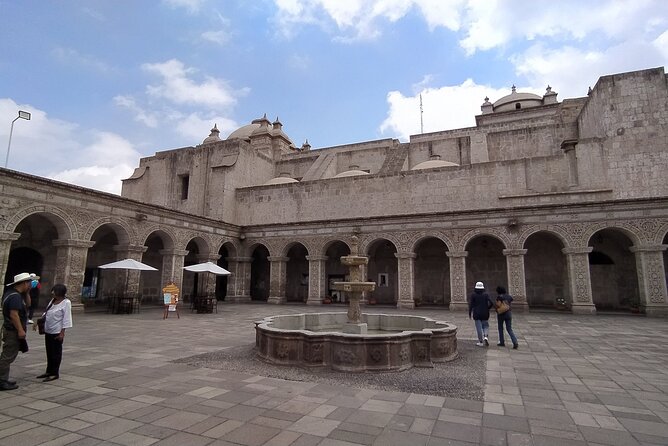
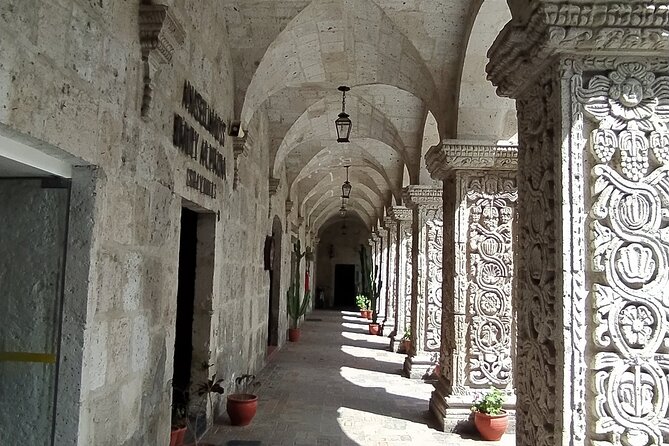
The route then spends about 40 minutes in the Cloisters of the Company, formerly part of a Jesuit school and convent. The complex is described as one of the finest examples of religious viceregal architecture in Arequipa.
This is the longest scheduled stop, and it gives the architectural side of the tour room to breathe. The cloisters offer arcades, enclosed courtyards, and a quieter setting after the streets and market. Your guide can connect the buildings to the Jesuits, colonial education, religious life, and the styles that developed in the city.
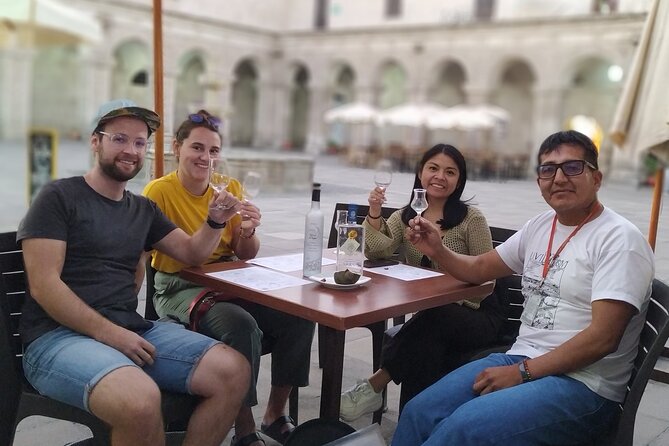
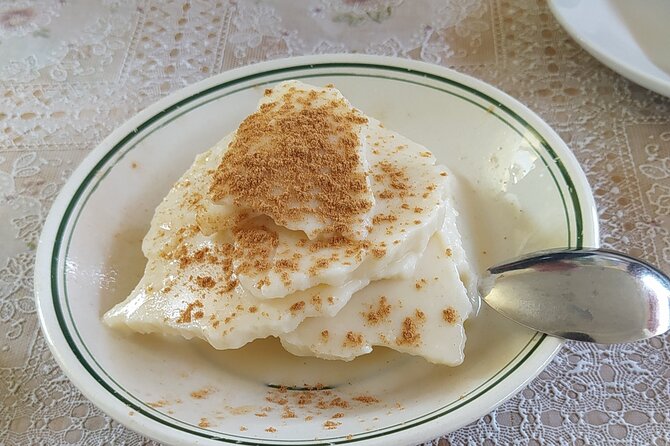
The tasting takes place at Centro Artesanal Fundo el Fierro, where the tour finishes near Plaza San Francisco. You should expect pisco, a traditional dessert called queso helado, and local fruit. The queso helado is not a cheese dish. Its name refers to the traditional dessert’s style and texture, and it is one of the most praised food moments on this route.
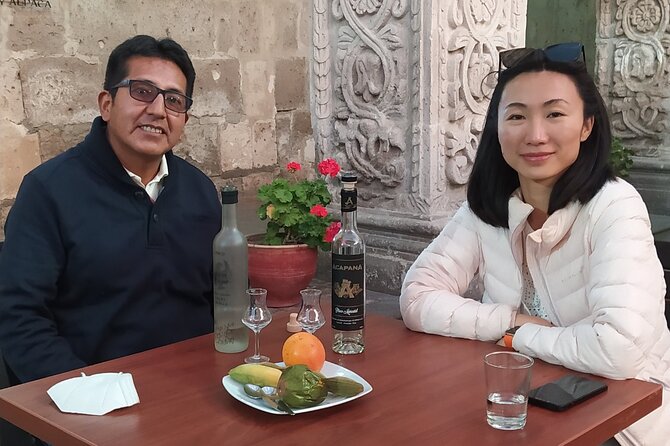
The pisco portion is more than a quick pour. Guides have explained how pisco is made and introduced the drink’s place in Peruvian culture. Depending on the arrangement, you may taste pisco itself or have a pisco sour. One account also praised the pisco sour served at the tasting location, but the official inclusion is pisco tasting, so do not assume a particular cocktail.
This final stop is a pleasant change of pace. After churches, plazas, and market aisles, you can sit or pause with something to taste and ask final questions. It is also the point that exposes the tour’s biggest mismatch with its name: the culinary portion is concentrated at the end.
What the $13 price really gives you
At $13 per person, this is an unusually low-cost way to get a guided introduction to central Arequipa. You receive about three and a half hours of guiding, a small group, market visits, fruit, queso helado, and pisco. There are no listed admission charges included, but the itinerary itself is built around public spaces and exterior viewing, so this does not undermine the value much.
The price is strongest if you are new to Arequipa and want a framework for later exploring. A good guide can help you understand why a plain-looking street matters, which church deserves a return visit, and how the market fits into local life. The value is less clear if you already know the historic center and are booking mainly for a long tasting session.
Several guides have been praised for being generous with their time and answering many questions. That matters more than a polished script on a small walking tour. The experience depends partly on the guide’s ability to balance architecture, history, and food. José, Daniel, and Jorge have each been associated with warm, informative tours, but the operator does not promise a particular guide.
Timing, fitness, and practical planning
The start is at Plaza de Armas and the finish is at Plaza San Francisco, at or near Fundo el Fierro. Since both points are in central Arequipa, the route is useful as a first-day orientation. You can continue sightseeing after the finish instead of returning to a distant transport hub.
The tour requires a moderate level of physical fitness. The supplied details do not specify stairs, steep sections, or exact walking distance, but you should be comfortable walking between several central stops for more than three hours. Comfortable shoes are sensible, and carrying water is important because bottled water is not included.
Service animals are allowed, and the route is near public transportation. Entrance tickets are not included, so ask before booking if you hope to enter a specific church or cloister beyond the areas included in the walk.
The cancellation terms are flexible if your plans change early. You can cancel for a full refund up to 24 hours before the local start time. Changes made inside that window are not accepted, and poor weather can lead to a new date or full refund.
Who will get the most from this walk
I would choose this tour for a first visit to Arequipa, especially if you want history and food in one compact outing. Solo visitors and couples should find the group size comfortable, while families can use the guide’s explanations to make the city’s buildings easier to understand.
It also suits anyone who wants a market visit without having to work out where to go alone. San Camilo is the route’s strongest local-food stop, and the guide can help you make sense of unfamiliar produce.
I would think twice if you expect a dedicated food crawl. Only the market and final tasting are clearly culinary stops, and the tasting is held late. I would also avoid booking it immediately after a large lunch if you want to enjoy the food samples, but do not skip food entirely for an afternoon departure because lunch is not supplied.
Should you book the Arequipa Tasting Tour?
Book it if you want a low-cost, small-group introduction to Arequipa with a real market visit and a modest tasting at the end. The combination of Plaza de Armas, Jesuit architecture, San Camilo Market, queso helado, fruit, and pisco gives you a useful first look at the city.
Do not book it expecting three hours of continuous eating. The better description is a history and architecture walk that finishes with local flavors. If that balance suits you, the $13 price makes this an easy choice, particularly at the beginning of your stay.
FAQ
Where does the Arequipa Tasting Tour begin?
The tour begins at Plaza de Armas in Arequipa, Peru.
Where does the tour finish?
It finishes at Centro Artesanal Fundo el Fierro near Plaza San Francisco, at C. Zela 202, Arequipa.
How long does the tour last?
The tour lasts approximately three hours and thirty minutes.
How much does the tour cost?
The listed price is $13 per person.
What food and drink are included?
The tour includes a pisco tasting, a traditional dessert called queso helado, and local fruits.
Is lunch included?
No. Lunch is not included, and people taking the tour in the afternoon are advised to eat beforehand.
Is bottled water included?
No. Bottled water and soda are not included.
What places does the walking route visit?
The route includes Plaza Campo Redondo, San Francisco Plaza, the area around Santa Catalina, Plaza de Armas, the Church of the Company of Jesus, San Camilo Market, and the Cloisters of the Company.
How many people can join the tour?
The tour has a maximum of eight participants.
Can I cancel for a full refund?
Yes. You can cancel at least 24 hours before the local start time for a full refund. Cancellations or changes made less than 24 hours before the start are not accepted, and poor weather may result in a different date or a full refund.
New food tours we have reviewed in the world
- ChattaBrunch Food Tour★ 5.0 · 87 reviews
- Downtown Chattanooga Food Tour★ 5.0 · 290 reviews
- Charlottetown waterfront SOLAR PartyBike food & drink experience!★ 4.0 · 92 reviews
- Historic Southside Food Tour in Chattanooga★ 5.0 · 32 reviews
- Tastes Through Time – Charleston’s Best Food & History Tour★ 4.5 · 95 reviews
- Charleston’s Savor the Flavors of Upper King Street Walking Food Tour★ 4.5 · 130 reviews
- Charlottetown Food Walking Tour★ 5.0 · 59 reviews
- Charleston Private Brunch Tour: Biscuits, Shrimps, Grits and More★ 5.0 · 48 reviews
Tours, compared.
Dubai: Old Town, Creek, Museums, Souks, & Street Food Tour
Read our review →
Ho Chi Minh City Street Food Tour & Sightseeing By Motorbike
Read our review →
Montserrat Half-Day Tour with Tapas and Gourmet Wines
Read our review →
Dubai: Old Town, Souks, Street Food, Guided Tour & Abra Ride
Read our review →
Tokyo: Shinjuku Food Tour (13 Dishes at 4 Local Eateries)
Read our review →
Winner 2025 Undiscovered Lisbon Food & Wine Tour by Eating Europe
Read our review →
Hanoi: Guided Food Tour with Train Street Visit
Read our review →