
Review · FOOD WALKING TOURS
Private Charleston Walking Food Tour at the French Quarter
Charleston’s French Quarter is best understood one bite at a time. This private walking tour pairs Southern food with stories of the port, the slave trade, theater, and the people who shaped the city’s table. You’ll walk for about three and a half hours, beginning near the United States Custom House and finishing around Queen and Meeting Streets or East Bay Street.
I like the small private format, since your guide can shape the pace around your group. I also like the food lineup: chicken bog, she-crab soup, shrimp and grits, benne wafers, a pecan sweet, and a secret dish give you a useful introduction to Charleston cooking without sending you across town.
The main caution is the $370 per person price. That is a serious outlay for a walking tour, and the food may not satisfy diners seeking Charleston’s very best restaurant cooking. Dietary restrictions can also be difficult to handle, so contact the company before you reserve.
Key points to know before booking
- A private 3.5-hour walk: Only your group takes part, with time for questions and a flexible pace.
- Six named tastings plus a secret dish: Expect Southern staples, seafood, sweets, and ingredients tied to Charleston’s past.
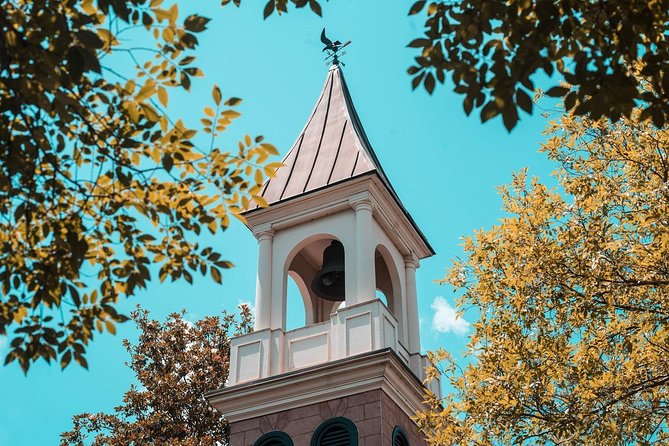
- Three notable city stops: The Custom House, Charleston City Market, and Dock Street Theatre anchor the route.
- Guide quality matters: Kelli stepped in when another guide failed to arrive, while Hannah earned praise for her Charleston commentary.
- Dietary needs need advance planning: Some restrictions cannot be accommodated because the menu is designed as a balanced food experience.
- The route ends near the start: You finish at Queen and Meeting Streets or East Bay Street, both close to the opening area.
Starting at the Custom House and East Bay Street
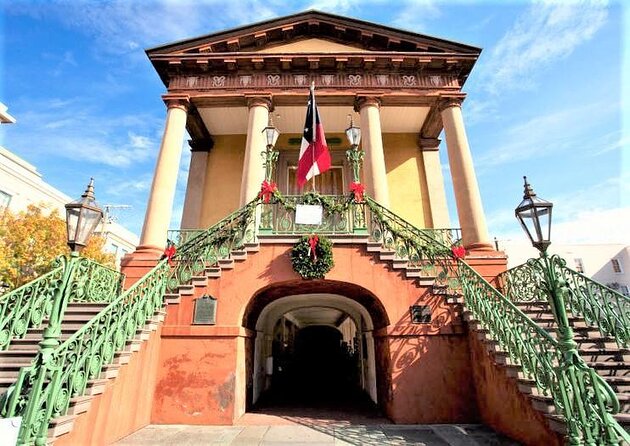
The tour begins at 99 South Market Street, suite 5, while the first sightseeing point is the United States Custom House on East Bay Street. Since the supplied meeting details and first stop use different descriptions, I would confirm the exact meeting spot and time after booking.
The Custom House makes a fitting opening. Its grand position facing East Bay Street and the harbor reflects Charleston’s importance as a port city. You begin with architecture and commerce before moving toward food, which helps explain why Charleston cooking draws from so many traditions.
This is not simply a stop for a quick photograph. The building represents the federal presence that followed Charleston’s growth as a major American port. Your guide can use the setting to explain how goods, people, money, and ideas moved through the city.
The location is also practical. It is near public transportation, and the route remains within the historic district. You will not need a taxi between sights, though you should expect plenty of time on your feet. Comfortable walking shoes are essential.
More Food Walking Tours in the USA
- Savor the Flavors of Charleston Walking Food Tour
★ 4.5 · 881 reviews - Charleston’s Savor the Flavors of Upper King Street Walking Food Tour
★ 4.5 · 130 reviews - Charleston: Downtown Culinary Walking Tour
★ 5.0 · 53 reviews
Charleston food with a story behind it
The tastings are meant to do more than fill you up. They connect dishes and ingredients to the city’s past, including the influence of Africans brought through the slave trade. At the City Market, you learn how ingredients such as benne seeds and collard greens became part of local foodways.
That context gives the food a needed human dimension. Benne seeds, for example, are not just a crunchy garnish. Their presence points to West African agricultural knowledge and the people who carried that knowledge to the American South under terrible conditions.
The menu includes a fluffy cheese and chive biscuit, a familiar Southern form given a savory lift. You also receive crisp benne wafers, which offer a direct taste of the ingredient discussed at the market. These smaller samples help keep the tasting varied rather than making the whole experience a parade of heavy plates.
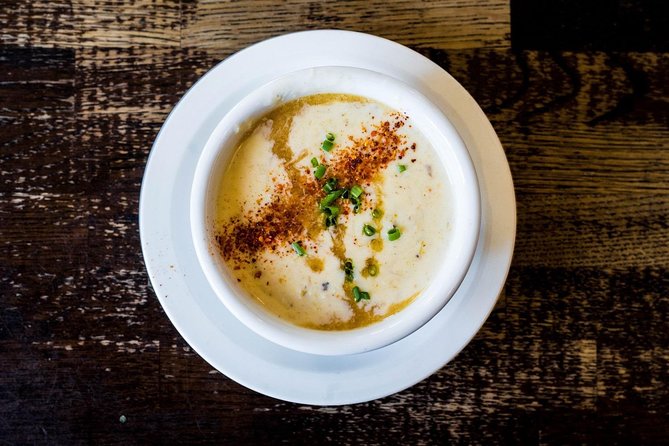
The savory dishes are more substantial. Chicken bog is a South Carolina specialty built around chicken and rice, with a comforting, home-style character. She-crab soup brings cream and crab together in a dish closely tied to the Lowcountry.
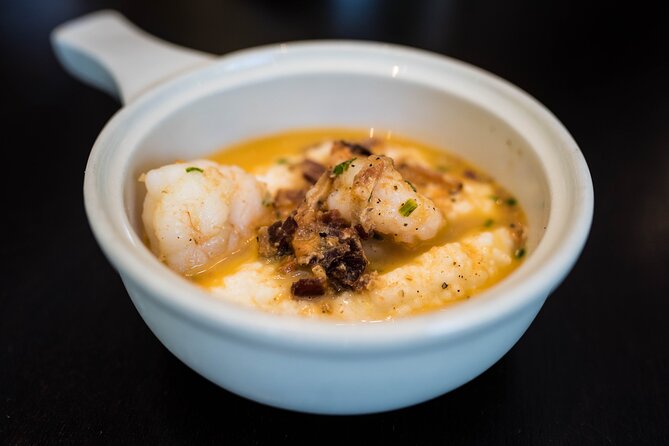
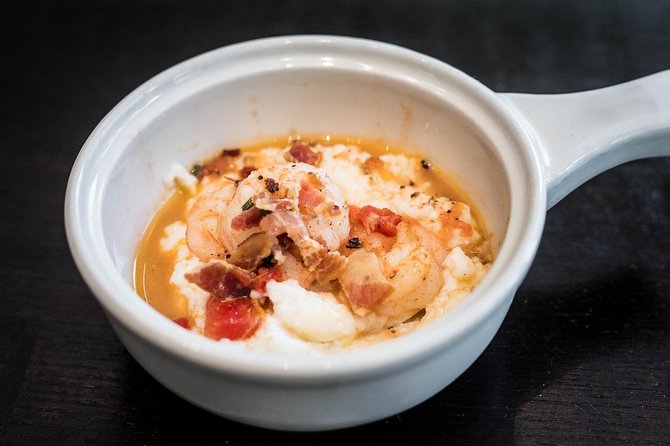
Shrimp and grits completes the main savory portion. It is one of the region’s best-known combinations, but its inclusion is still useful for first-time visitors who want to understand the local food vocabulary.
You also receive a handmade pecan cluster and a secret dish. The secret item is intentionally not described in advance, so you will have one small surprise along the way. The menu can change because of restaurant availability, weather, or other circumstances, so treat the published tasting list as a guide rather than a guarantee.
Walking through Charleston City Market
Charleston City Market is one of the route’s most useful stops because it links food, trade, and public life. As you stroll through the market, the guide can place the tastings in a broader setting rather than presenting them as disconnected samples.
The market is also where the tour’s discussion of African influence becomes especially important. Learning about benne seeds and collard greens here makes the food feel less like a collection of generic Southern favorites and more like a record of migration, forced labor, adaptation, and survival.
You may find the market more crowded or active at certain times, and the tour’s pace can change with conditions. That is worth remembering if you prefer a quiet, highly controlled food lesson. This is a working public space, not a private dining room.
Still, I consider the market an effective part of the route. You get a sense of Charleston’s public face while tasting foods that have become part of the city’s identity. It is also a good point to ask questions, since the private format gives you more room to steer the conversation.
Dock Street Theatre and Charleston’s performance tradition
The Dock Street Theatre adds a different note. It was the first theater building in America designed solely for theatrical performances, giving the tour a cultural stop beyond food and port history.
Its inclusion keeps the walk from becoming too narrowly focused on restaurants. Charleston’s identity has always involved performance, public display, architecture, and social tradition as well as cooking. The theater helps show how the city’s cultural life developed from the 1700s into the modern era.
You will not spend the whole tour inside attractions. This is a walking food tour with exterior sightseeing and historical explanation, so anyone hoping for long indoor visits should choose a different activity. The reward is a route that keeps moving through the old district rather than parking you at one venue.
The theater also gives your guide another way to discuss change over time. Food and performance both reveal who had power, who had access, and whose traditions became part of Charleston’s public image.
More Food Walking Tours in Charleston:
- Reykjavik Food Walk – Local Foodie Adventure in Iceland
★ 5.0 · 18,952 reviews - New Orleans Food Walking Tour of the French Quarter with Small-Group Option
★ 5.0 · 6,118 reviews - Naples: Street Food Walking Tour with Local Guide
★ 4.9 · 4,976 reviews - Greek Food Walking Tour in Athens
★ 5.0 · 4,740 reviews
What the food portion is really worth
At $370 per person, the tour is priced as a private experience rather than a basic tasting walk. Your group is not joining strangers, and the guide can answer your questions, adjust the rhythm, and focus the conversation around your interests.
That price can make sense for a special occasion, a family group, or friends who value privacy and a planned introduction to Charleston. Group discounts may also improve the value, depending on the size of your party.
I would not book it mainly as a bargain meal. The portions are tastings, not a full restaurant lunch, and the culinary quality can vary by stop. One published experience described the food as acceptable to good, with only one dish making a particularly strong impression, while the Charleston information was the real highlight.
That is useful guidance. You may enjoy the food and still find that the historical storytelling carries the tour. If your main goal is to discover Charleston’s most exciting restaurant cooking, you could spend less or more strategically by eating at individual restaurants yourself.
The private setup remains the strongest value point. A guide can respond to your group instead of delivering a fixed speech to a large crowd. Kelli, for example, stepped in when the scheduled guide did not arrive and still provided an outstanding experience. That kind of recovery matters, though it also suggests you should pay attention to final confirmation details.
Hannah received particular praise for her pleasant manner and Charleston commentary. The guide can shape your impression of the entire tour, so the personal side of this experience is as important as the menu.
Timing, walking, and practical comfort
The tour lasts about three hours and thirty minutes. That is long enough for several tastings and a useful historical walk, but it also means you should plan your day around it rather than squeeze it between tight reservations.
Wear comfortable walking shoes. Charleston’s historic streets can make a long walk tiring, and you will be stopping to eat as well as moving between locations. The tour is near public transportation, but hotel pickup and drop-off are not included.
The route starts near the Custom House and ends at either Queen Street and Meeting Street or East Bay Street, about one block from the starting area. This makes it easy to continue exploring the French Quarter afterward, though the exact end point may change.
The tour operates in English. Most people can participate, but the experience requires a reasonable ability to walk for more than three hours. The company also lists weather as a factor, and the itinerary or menu may change when conditions or venue availability require it.
Booking about thirteen days ahead is the average pattern for this experience. I would not treat that as a hard rule, but it is sensible to reserve early if your Charleston dates are fixed, especially since this is a private activity with limited availability.
Dietary restrictions deserve a direct conversation
This tour is not a safe choice for every diet. The company specifically warns that some dietary restrictions cannot be accommodated because the food experience is designed as a balanced sequence of dishes.
Contact the provider before booking, not just after arrival. Ask clearly about allergies, vegetarian needs, gluten restrictions, seafood concerns, or other requirements. The listed menu includes chicken, crab, shrimp, dairy, wheat-based biscuits, and nuts, so several common restrictions may affect the tasting plan.
A request sent in advance gives the company a chance to say what is possible. It also prevents you from paying for a food tour that cannot provide enough suitable samples.
If your group has no major restrictions, the range of dishes is a strength. You get savory and sweet tastes, seafood and poultry, familiar Southern forms and less familiar ingredients such as benne. If your diet is limited, the food value drops sharply unless the company confirms workable alternatives.
Who will enjoy this Charleston walk?
I would recommend this tour most strongly to first-time Charleston visitors who want history and food in one outing. It gives you an introduction to the French Quarter, several regional dishes, and a guide who can connect the pieces.
It also suits families or friends who want a private schedule. You can ask about architecture, slavery, theater, cooking, or Charleston’s port without worrying about slowing down a large group.
It may work well near the start of a Charleston stay. The route introduces foods and central sights that can help you decide what deserves more time later. You can use the end of the walk to explore nearby streets or continue with your own meal plans.
I would be more cautious if you are a serious food traveler focused on standout restaurant dishes. The menu is educational and representative, but the quality may not match the city’s top dining rooms. The tour’s strongest feature is the combination of guide and setting, not a promise of one exceptional dish after another.
The cancellation terms are straightforward: cancel at least 24 hours before the start for a full refund. Changes or cancellations inside 24 hours are not refunded, and poor weather or failure to meet the minimum group size can lead to a new date, another experience, or a full refund.
Should you book the French Quarter food tour?
Book it if you want a private introduction to Charleston that mixes local dishes with clear historical context. The Custom House, City Market, and Dock Street Theatre create a well-chosen route, and the menu gives you a practical taste of Lowcountry cooking.
Think carefully about the price and your expectations. At $370 per person, you are paying for privacy, guiding, and the planned connection between food and place, not simply for a meal. If the guide is the main reason you are booking, the strong work described from Kelli and Hannah is encouraging.
Skip it if your top priority is low cost, a full meal, or cutting-edge food. Also skip it, or contact the provider first, if your dietary needs are complex.
For the right group, this is a thoughtful way to get oriented in Charleston. You will leave with several flavors to remember, a better grasp of the city’s past, and a convenient starting point for exploring the French Quarter on your own.
FAQ
Where does the Charleston food tour start?
The meeting point is listed as 99 S Market Street, suite 5, Charleston, South Carolina 29401. The first sightseeing stop is the United States Custom House, so confirm the exact meeting instructions after booking.
Where does the tour end?
The tour ends either at Queen Street and Meeting Street or on East Bay Street, about one block from the starting area.
How long does the tour last?
The walking food tour lasts approximately three hours and thirty minutes.
What food is included?
The listed tastings include chicken bog, a cheese and chive biscuit, she-crab soup, a pecan cluster, benne wafers, shrimp and grits, and a secret dish. The menu can change because of availability, weather, or other circumstances.
Can the tour accommodate dietary restrictions?
Some dietary restrictions may not be possible to accommodate. Contact the provider before booking so the company can explain what may be available for your needs.
Is hotel pickup included?
No. Hotel pickup and drop-off are not included, but the tour begins near public transportation.
New food tours we have reviewed in Charleston
- Tastes Through Time – Charleston’s Best Food & History Tour★ 4.5 · 95 reviews
- Charleston’s Savor the Flavors of Upper King Street Walking Food Tour★ 4.5 · 130 reviews
- Charleston Private Brunch Tour: Biscuits, Shrimps, Grits and More★ 5.0 · 48 reviews
- Charleston Farm-to-Table Food Tour and Chef’s Challenge★ 5.0 · 110 reviews
- Charleston Upper King Street Food Tour★ 4.5 · 200 reviews
- Charleston Brunch Food Tour: Biscuits, Shrimps, Grits and More★ 5.0 · 239 reviews
- Charleston: Small Group Food Tour – Savor the Flavors★ 4.7 · 169 reviews
- Charleston: Downtown Culinary Walking Tour★ 5.0 · 53 reviews
Food Walking Tours, compared.
Reykjavik Food Walk – Local Foodie Adventure in Iceland
Read our review →
New Orleans Food Walking Tour of the French Quarter with Small-Group Option
Read our review →
Naples: Street Food Walking Tour with Local Guide
Read our review →
Savannah First Squares Culinary & Cultural Walking Food Tour
Read our review →
Rome: Guided Food Walking Tour with Wine in Trastevere
Read our review →
Rome: Trastevere & Campo de Fiori Street Food Walking Tour
Read our review →Browse the lists this tour appears in