
Review · MARRAKECH FOOD TOURS
Authentic Moroccan Food Tour in Marrakech with Dinner
Marrakech’s food culture makes more sense when you taste it in the places locals actually buy and eat it. This three-hour evening tour threads through the medina around Jemaa el-Fna, stopping for pastries, soup, olives, pancakes, snails, fruit, and other specialties before ending with dinner on a rooftop.
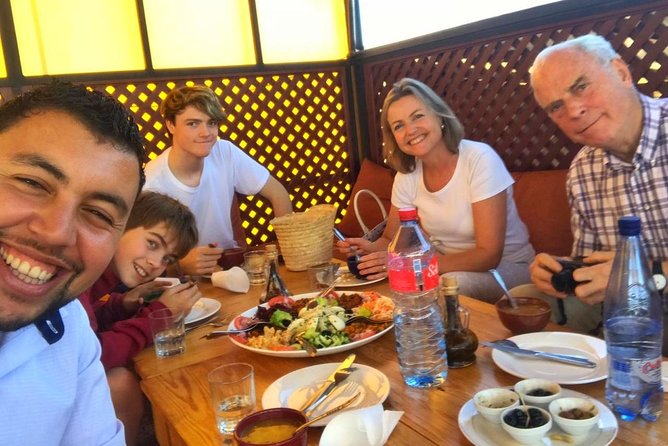
I like the broad range of food and the way guides such as Mehdi, Hamza, Ali, and Mohamed explain what is in front of you. I also like the social setup: a small group, several shared tastings, and a sit-down meal that gives you time to compare notes.
The main caution is consistency. Most accounts describe a generous food-filled evening, but a few report a rushed route, a missing mint tea, or confusion about the final dinner. The herbalist-shop stop can also feel like a sales detour rather than part of a food tour.
Key points at a glance
- Around 10 tasting stops: Try Moroccan pastries, harira, chebakia, olives, msemen, snails, fruit, and other local foods.
- Two possible food routes: Your guide chooses between itineraries based on the guide, season, and pace of the evening.
- Rooftop dinner included: The experience is intended to finish with a three-course Moroccan meal near the meeting point.
- Local guides shape the evening: Mehdi, Hamza, Ali, Mohamed, Houssaine, and Mo are among the guides associated with especially strong experiences.
- Small-group format: The maximum group size is 15 people, though one account describes a larger, uncomfortable group.
- Come hungry: The tastings plus dinner can add up to a very substantial meal.
Why this tour works well in Marrakech
Food is a useful way to get oriented in Marrakech. The medina can feel like a maze at first, with food stalls, cafés, bakeries, spice shops, and tiny eateries packed into narrow lanes. A guide gives you a reason to pause and a way to understand what you are seeing.
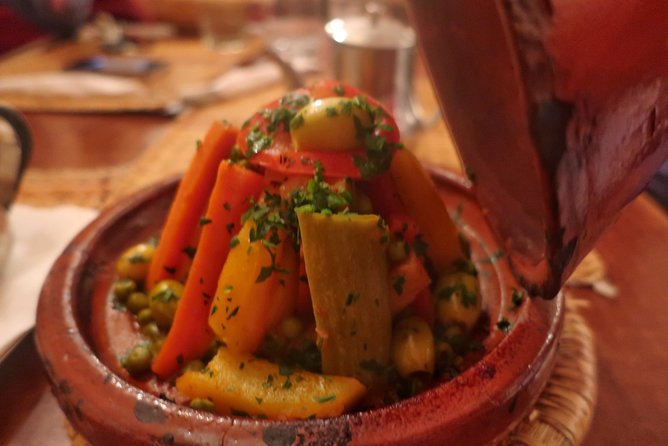
This is not simply a restaurant meal with a short explanation attached. You move from bite to bite, often eating foods that are easy to overlook if you only follow the main tourist paths. Some stops are familiar, such as mint tea and Moroccan pancakes. Others, including snail soup or steamed sheep’s head seasoned with cumin, may take more nerve.
I see the greatest value in the variety. You are not asked to choose one dish from a menu and hope for the best. Instead, you sample many small portions and learn how sweet, savory, spicy, sour, and herbal flavors fit into everyday Moroccan eating.
The price is $54.45 per person. That is not the cheapest way to eat in Marrakech, but it includes the guide, multiple tastings, mint tea, and dinner. If you would otherwise pay separately for several snacks and a three-course meal, the price is reasonable. The value depends heavily on how much food is served and whether the dinner is actually provided as planned.
More evening meals in Morocco:
- Marrakech: Jemma El Fnaa Food Tour with Dinner
★ 4.7 · 394 reviews - Marrakech: Authentic Moroccan Food Walking Tour & Dinner
★ 4.8 · 261 reviews - Bateaux Parisiens Seine River Gourmet Dinner & Sightseeing Cruise
★ 4.5 · 6,930 reviews
Meeting near the Poste du Maroc
The tour begins at Poste du Maroc on Rue Beni Marine, close to the heart of the medina. This is a practical meeting place because the evening stays focused on the old city rather than spending time on hotel transfers.
You should allow extra time to reach the starting point. The medina’s lanes can be confusing, and the tour does not include hotel pickup or drop-off. Public transportation is nearby, but the supplied details do not promise transport from your accommodation.
The route lasts about three hours. The first and final portions are listed as roughly 30 minutes each, with about an hour assigned to each of the two main tasting routes. In real use, the pace can vary. One account describes a 30-minute delay that was communicated in advance, while another describes a rough start after a guide change.
The operator allows free cancellation up to 24 hours before the start time. After that point, the payment is not refunded, and late changes are not accepted.
Two routes through the Medina
The exact food lineup is not fixed. The tour has two possible routes, and your guide may choose one based on the season, the guide, or the flow of the evening. That flexibility can keep the experience local and practical, but it also means you should not expect every item listed below.
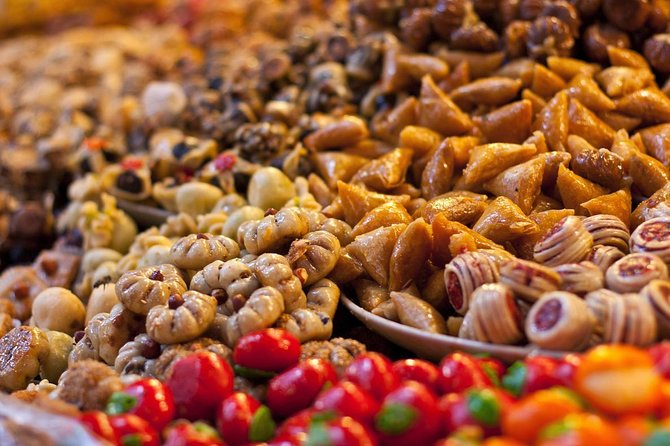
The first route includes Moroccan coconut macaroons, a sweet treat often enjoyed by children, and kaab ghzal, a pastry filled with almond paste and scented with orange blossom water. These give you an early lesson in the country’s love of nuts, perfume-like floral notes, and delicate pastry.
You may also try harira with dates and chebakia. Harira is a traditional soup, and the combination is strongly linked with breaking the fast during Ramadan. Even outside Ramadan, it shows how Moroccan food often pairs a warm, savory bowl with a sticky, sweet pastry.
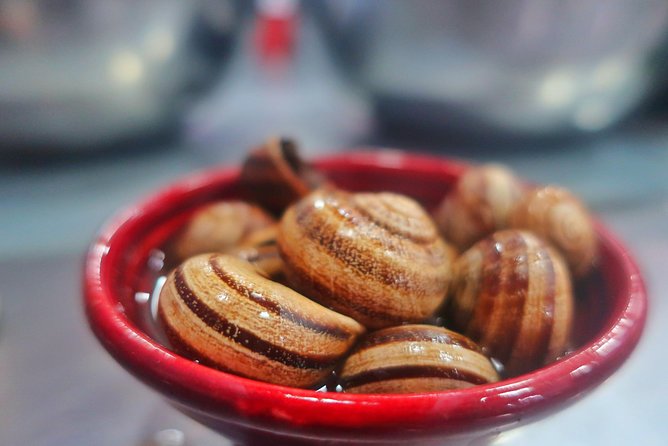
Babbouche, or Moroccan snails, is one of the more unusual tastings. The snails are slowly cooked in an aromatic herbal broth. If you are curious about local street food, this is a useful stop. If you dislike shellfish or strongly flavored broths, you may want to ask your guide about alternatives.
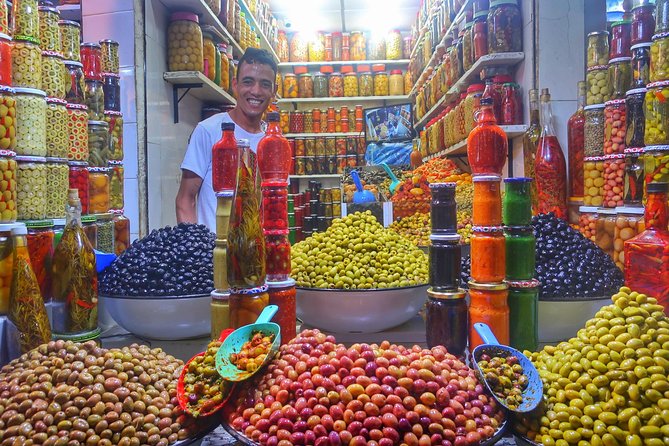
The route may continue with mint tea and msemen, a pan-fried pancake that can be served with honey and cheese. Fakya, a mix of dried fruit and nuts prepared for celebrations, adds another look at Moroccan hospitality. The final listed tasting is a selection of Moroccan olives, ranging from green varieties to creamy-textured options.
The second route leans more heavily toward savory street food. Msemen Amer is a stuffed version of the familiar Moroccan pancake, often filled with seasoned vegetables. It is the kind of snack that works well at teatime and makes the plain pancake seem like a completely different dish.
You may then have harira with chebakia, followed by makkla bel kefta, a Moroccan take on shakshouka. Sfenj is another highlight: a traditional donut with a crisp exterior and airy, chewy center. These foods give the route a satisfying mix of soup, pastry, egg-based comfort food, and fried dough.
Lhindiya, or cactus fruit, brings a cool, fresh note after the heavier dishes. Panaché, a smoothie made from seasonal fruit, serves a similar purpose. Khoudenjal is a hot Moroccan drink, while rass mbekher is delicately steamed sheep’s head seasoned with cumin.
That last item is not for everyone, but it reflects the tour’s aim to show more than the safest tourist choices. You can approach it as a small taste rather than a full serving. The guide should be able to explain what you are eating and help you decide how adventurous you want to be.
What makes the Jemaa el-Fna stops useful
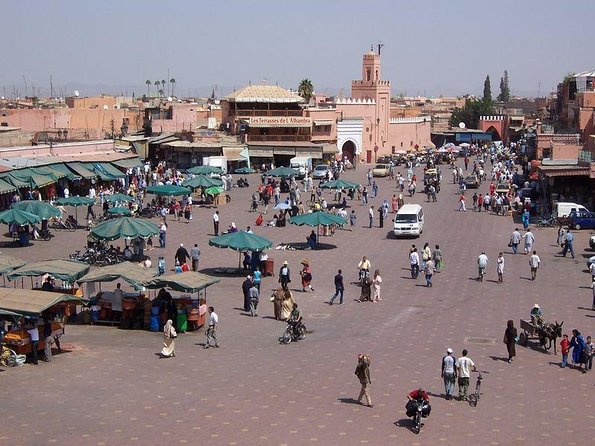
Jemaa el-Fna is one of Marrakech’s main gathering places, and food is part of its nightly character. The tour helps you see the square as a place where people eat ordinary local dishes, not only as a photo stop.
The best part of a guided route is the context. Harira is not just soup. Msemen is not just a pancake. Fakya is not just a bowl of nuts. Each item has a place in family life, celebrations, fasting traditions, tea time, or street eating.
The narrow lanes also make a guide valuable for simple practical reasons. A guide can lead you from one stop to the next, manage the order of the tastings, and explain the food before you try it. Several guides, including Hamza, Mo, and Mohamed, are praised for keeping the group comfortable and adding cultural or historical detail beyond the food itself.
You should expect to walk and stand between stops. Seating may be limited at small stalls or local eateries. One disappointing account describes a large group trying to fit around tiny food places, so the experience is best when the advertised maximum of 15 is respected.
More restaurant experiences in Morocco:
- Sorrento Farm and Food Experience including Olive Oil, Limoncello, Wine tasting
★ 5.0 · 2,524 reviews - Rome: Gourmet Food Tour with Dinner & Barolo Wine
★ 4.9 · 2,347 reviews - Porto Food & Wine Tasting Tour with Lunch or Dinner Option
★ 5.0 · 2,303 reviews - Lisbon: Baixa District Food Tour with Dinner and Drinks
★ 4.9 · 1,997 reviews
The rooftop dinner near the end
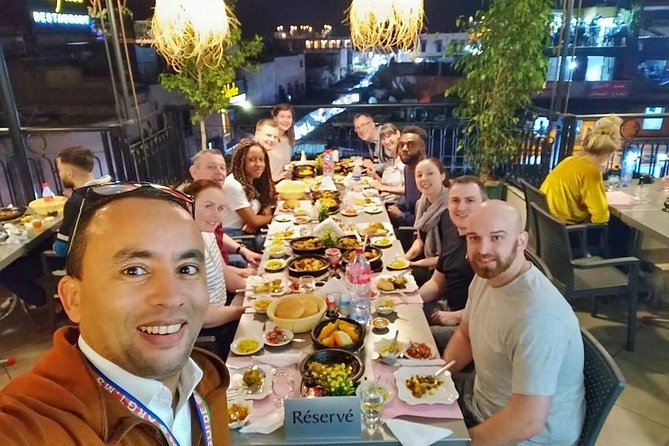
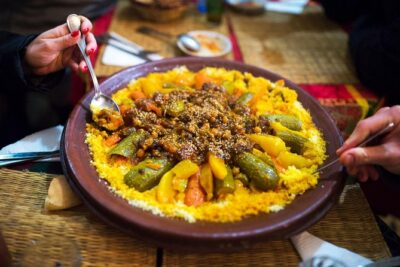
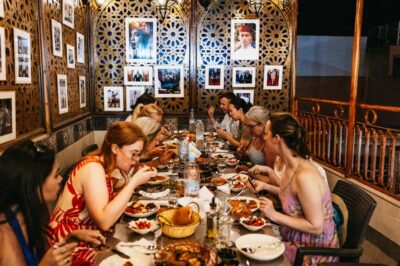
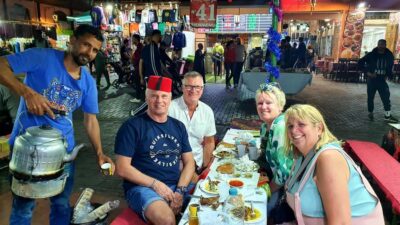
The evening is meant to finish with a three-course Moroccan dinner at a rooftop restaurant near the first meeting point. This is important because the earlier samples are not the whole meal. You can expect to sit down, slow the pace, and eat a proper dinner after working through the medina.
The rooftop setting is one of the strongest details of the experience. From there, you can look back toward the square and the old city while eating. One listed menu description says there are various menu options, but the exact dishes are not provided, so you should not book this expecting a particular tagine, couscous, or dessert.
Several accounts specifically praise the final meal, including the rooftop view and the chance to finish with dessert. One person described being so full that dessert had to be taken away. That gives you a useful warning: eat lightly before the tour.
There is also a point you should clarify before booking. One account says the tour included only food stalls and no dinner, while many others describe a sit-down meal and dessert. Since the advertised experience includes dinner, confirm the evening’s plan with the operator if that part matters greatly to you.
The herbalist stop deserves a question
Depending on the pace, the guide may stop at a traditional herbalist’s shop. This can be a pleasant pause where you learn about Moroccan spices, tea, and herbs, use the restroom, and take a break from walking.
It can also be the least appealing part of the evening. The supplied experience details describe it as a short stop, but some accounts describe a longer presentation involving remedies and products for sale. One person found the sales talk unnecessary, while another enjoyed the visit despite the fact that it was not food-focused.
My advice is simple: ask your guide how long the stop will last. If you are interested in Moroccan herbs and teas, it may add useful context. If you want every minute devoted to eating, you may find it a detour.
Guide quality and group size
The guide is central to this experience. The strongest accounts highlight guides such as Hamza, Mehdi, Houssaine, Ali, Mohamed, and Mo for friendly communication, clear explanations, and help navigating the medina.
A good guide also manages the difficult parts of the evening. That includes keeping the group together, explaining unfamiliar foods, handling delays, and making a solo participant feel included. One solo participant found the group a good way to connect with other people while learning about the food.
The listed maximum is 15 participants. That is small enough for questions and conversation, but it is not a private tour. For the best experience, you should be comfortable sharing dishes, waiting for others, and eating in compact spaces.
There have been occasional guide substitutions and communication problems. One evening began late because the original guide was unavailable, and a replacement guide took over after finishing another tour. The replacement eventually helped the delayed participant catch up, but the start was stressful.
If you are traveling with a stroller, mention it when booking. The medina route includes stairs and tight spaces, and one family had a difficult time moving a stroller in and out of restaurants. The general participation guidance says most people can take part, but that does not mean every route is easy with wheels.
Food needs, timing, and comfort
Vegetarian guests and people with specific dietary needs are asked to notify the operator after booking. The tour says those requests can be accommodated, but the food list includes meat, sheep’s head, snails, cheese, and other ingredients, so you should explain your needs clearly rather than simply saying you eat selectively.
The food comes in many small portions, but the overall amount can be large once dinner is added. You do not need to force yourself to taste every dish. A good guide should help you understand the options so you can make sensible choices.
Wear comfortable shoes and expect an evening on foot. The route moves through old-medina alleys and food areas, with periods of standing and possible stairs. Since the end point is back at the meeting point, you will not need to arrange a separate ride from a distant restaurant.
The activity is offered with a mobile ticket, and booking confirmation is provided at the time of reservation. A phone with the meeting details is useful, especially if your connection is unreliable. If plans change, remember that the cancellation deadline is 24 hours before the start time.
Who should book this Marrakech food tour
I would choose this tour if you want to taste widely but do not know where to begin in the medina. It is especially useful early in a Marrakech stay, when you can use the guide’s food tips for the rest of your time in the city.
It also suits solo visitors. The shared tastings and small group provide an easy social setting without requiring you to commit to an entire day with strangers.
Adventurous eaters will get the most from the route. Snails, cactus fruit, sheep’s head, stuffed pancakes, herbal drinks, and local pastries offer more range than a standard restaurant meal.
I would be more cautious if you need a tightly timed evening, dislike crowded food stalls, are traveling with a stroller, or want a guaranteed menu. I would also ask directly about the dinner and herbalist stop before paying, since those are the two parts with the most variation.
Should you book it?
At $54.45, this is a fair buy if the evening delivers the full package: multiple tastings, a guide who explains the food, mint tea, and a three-course rooftop dinner. The high overall rating and 98 percent recommendation figure support the idea that the experience usually works well.
The strongest reasons to book are the variety, the local food stops, the guides’ personal touch, and the rooftop finish. The main reasons to hesitate are occasional delays, uneven group size, the possible herbalist sales pitch, and conflicting reports about whether dinner was included.
Ask about the route, the final restaurant, and any dietary needs before the start. If those answers suit you, book hungry and treat the evening as a guided introduction to Marrakech’s food culture, not simply a restaurant reservation.
FAQ
How long does the Moroccan food tour last?
The tour lasts approximately three hours.
Where does the tour begin?
It begins at Poste du Maroc on Rue Beni Marine in Marrakech’s medina.
Where does the tour end?
The activity ends back at the meeting point.
Is dinner included?
Yes. The experience includes a three-course Moroccan dinner, with various menu options, at a rooftop restaurant.
How many people can join the tour?
The maximum group size is 15 participants.
What foods might I taste?
Depending on the route, you might taste Moroccan pastries, harira, chebakia, dates, snails, mint tea, msemen, olives, dried fruit, nuts, stuffed pancakes, shakshouka-style kefta, sfenj, cactus fruit, sheep’s head, seasonal fruit smoothies, and hot herbal drinks.
Can vegetarians or people with dietary needs join?
Yes. You should provide information about vegetarian or other dietary needs after booking.
Is hotel pickup included?
No. Hotel pickup and drop-off are not included.
Can I cancel for a full refund?
Yes. You can cancel up to 24 hours before the experience start time for a full refund. Cancellations or changes made less than 24 hours before the start are not refunded.
New food tours we have reviewed in Morocco
- Casablanca Food Tour★ 5.0 · 60 reviews
- Casablanca Food Tour – Moroccan Street Food Tour★ 5.0 · 86 reviews
- Discovery of Moroccan Culinary Heritage, History and Secrets★ 4.5 · 48 reviews
- Authentic Food Tour in Agadir – Eat Like A Local★ 5.0 · 117 reviews
- Tangier: Food Walking Tour★ 4.9 · 43 reviews
- Rabat: Walking Food Tour★ 4.9 · 48 reviews
- Marrakech: Medina Stories Food Tour with 15+ Tastings★ 5.0 · 141 reviews
- Marrakech: Authentic Moroccan Food Walking Tour & Dinner★ 4.8 · 261 reviews
Marrakech Food Tours, compared.

Marrakech: Authentic Moroccan Food Walking Tour & Dinner
Read our review →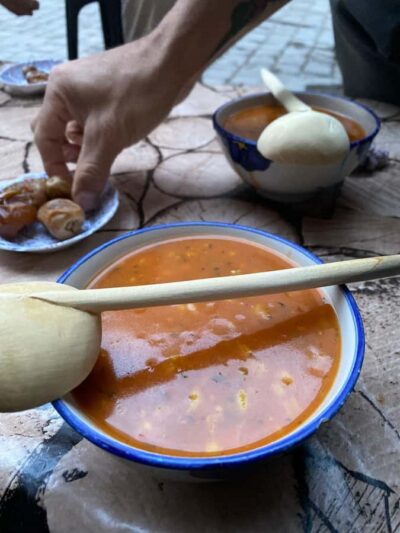
Marrakech Night Street Food Tour / Taste The Real Marrakech
Read our review →
Marrakech: Medina Stories Food Tour with 15+ Tastings
Read our review →
Medina Tasting Tour: Experience Local Street Food & Culture!
Read our review →Browse the lists this tour appears in