
Review · HISTORICAL TOURS
East Berlin Food & History Tour with Eating Europe
East Berlin’s food story is not really about sausages and sauerkraut. It is about Turkish workers, Syrian families, Vietnamese communities, and the people who turned former industrial spaces into places to eat, drink, dance, and make art. This small-group walking tour connects those stories with generous food tastings across Friedrichshain.
I especially like the way the tour links each dish to a piece of Berlin’s past, rather than treating food as a string of unrelated snacks. I also like the mix of everyday places, from a train-station currywurst counter to a tiny liquor shop and a Syrian restaurant. The main consideration is simple: come hungry, and expect a fair amount of walking with food that may feel more international than traditionally German.
Key things to know before booking
- Seven or more food and drink stops: Expect currywurst, döner, Vietnamese tacos, Syrian mezze, beer, and other samples, with the exact selection changing by day or season.
- Former East Berlin in a single afternoon: The route brings together Friedrichshain, RAW-Gelände, Warschauer Strasse, the East Side Gallery, and other local spots.
- A strong food and migration theme: You learn how Turkish, Vietnamese, Syrian, Middle Eastern, and other communities helped shape modern Berlin eating.
- Groups are capped at 12 people: That keeps the stops manageable and gives you room to ask questions.
- Guides make a major difference: Clara, Jed, Lily, Eden, Laura, and Benjamin have all led tours, with humor and clear historical storytelling repeatedly praised.
- Plan around your appetite: The tastings can cover lunch and part of dinner, so skipping breakfast is sensible.
Why this tour is about more than German food
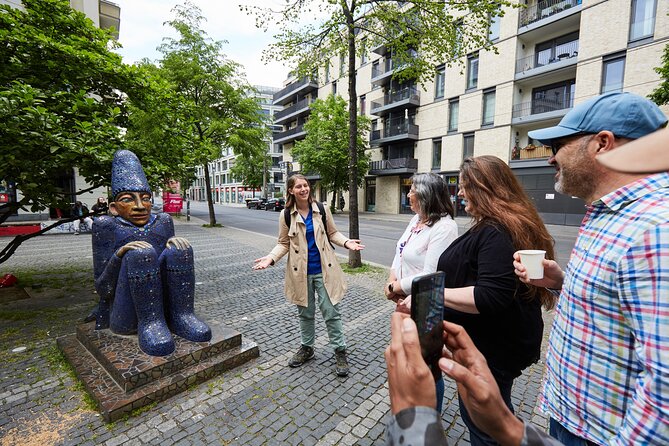
This tour works because it treats Berlin’s food as a record of the city’s recent history. You begin in Friedrichshain, a former East Berlin district that now has an energetic mix of restaurants, bars, clubs, markets, galleries, and converted industrial spaces.
The food is not presented as a museum display. You eat it in ordinary local settings. A döner stop explains the connection between Berlin’s street food and Turkish and Middle Eastern immigration. Vietnamese food points to another important part of the city’s modern story. Syrian mezze shows how newer arrivals have added their own flavors to Berlin’s dining culture.
That approach is one of the tour’s best features. If you want only classic German dishes, this may not be the right food walk. If you want to understand what Berliners actually eat today, the route gives you a much broader picture.
The group limit of 12 matters here. You are moving through small restaurants and compact food counters, not large tourist halls. A smaller group also gives you a better chance to ask about East Berlin, immigration, food traditions, or the city’s divided past. Guides such as Clara and Jed have been especially praised for answering questions and tying food to personal stories and wider events.
More history tours in Berlin:
- Barcelona: Tapas Walking Tour with Food, Wine, and History
★ 4.8 · 4,261 reviews - Sevilla Food Tour: Tapas, Wine, History & Traditions
★ 5.0 · 3,468 reviews - Madrid Tapas & Taverns Small Group Food & History Tour
★ 5.0 · 2,664 reviews
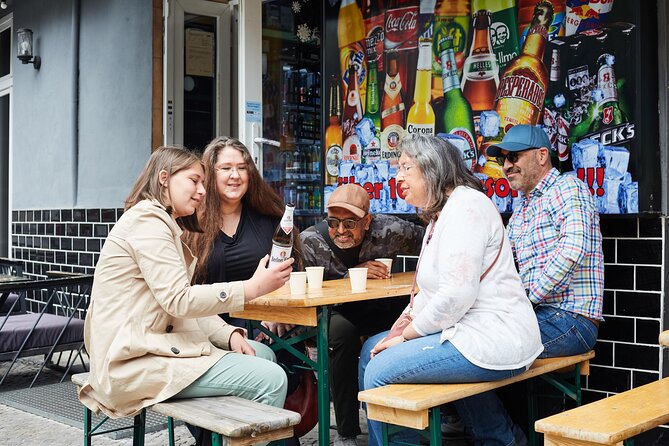
Starting with beer at Boxi Spatshop
The meeting point is Haroun at Neue Bahnhofstrasse 28, but the first listed tasting takes place at Boxi Spatshop on Boxhagener Strasse. The route begins with a Berliner Kindl light beer in a small liquor shop, a very Berlin way to start a food tour.
You get about 15 minutes here to learn about the beer and its place in local drinking culture. This is not a formal brewery visit, and admission is free because the drink is part of the tour. The setting helps establish the tone: the experience is built around normal neighborhood places rather than grand attractions.
Craft beer is included at selected stops, but extra drinks are not. That distinction matters if you plan to order beyond the provided tastings. You should also keep in mind that the drink list can change with the route and season.
Döner, migration, and Berlin street food
At Haroun, you try a shawarma-style döner and hear how Berlin’s street food developed alongside Turkish and Middle Eastern immigration. This is one of the most useful stops because it explains why döner is so closely tied to Berlin’s identity.
The portion is listed at about 20 minutes, so you should expect a focused tasting rather than a long restaurant meal. The point is to notice the food, hear its background, and continue through the neighborhood.
For many people, this may be the first sign that the tour is not a standard German food crawl. The city’s food culture grew through movement, work, family businesses, and adaptation. You get a practical lesson in that process while eating one of Berlin’s best-known quick meals.
Vietnamese tacos at NYOM
NYOM gives the route a more playful turn. This neon-lit Vietnamese restaurant serves TyTy Tacos, an inventive street-food dish packed with flavor. The stop lasts about 30 minutes, giving you more time to eat and hear how Vietnamese food fits into Berlin’s wider food scene.
This is one of the stops most likely to surprise you. A Vietnamese taco is not a classic Berlin dish, but that is exactly the point. Modern Berlin food is full of combinations and new ideas, shaped by communities that have made the city home.
The exact offering may vary, so do not book expecting one fixed menu item every time. The company says that the tastings and stops can change by day or season. That flexibility can be a drawback if you want a tightly fixed food itinerary, but it also means the tour can use current local places rather than repeat an unchanging script.
More food tours in Berlin:
- Berlin Center Food Tour with 8+ Authentic Local Tastings
★ 5.0 · 1,227 reviews - Kreuzberg: Culinary Food Tour
★ 4.5 · 770 reviews - Berlin: Mitte Culinary Food Tour
★ 4.5 · 447 reviews - Berlin: Downtown Food Tour with 8 Authentic Local Tastings
★ 4.8 · 342 reviews
RAW-Gelände and the city’s rough edges
Between tastings, you visit RAW-Gelände, a former rail repair yard, Soviet factory, and Deutsche Bahn warehouse. Its current use includes art spaces, record companies, nightclubs, beer gardens, a bouldering hall, and Berlin’s largest indoor skate park.
You get about 20 minutes here, enough to understand the site’s changing purpose and see why this part of Friedrichshain attracts people looking for something less polished than central Berlin. It is a useful pause from eating and a reminder that Berlin’s modern character often grew from old industrial buildings.
The tour does not treat RAW-Gelände as a separate sightseeing excursion. It is part of the food and city story. You see how former work sites can become social spaces, and how the neighborhood’s identity has changed since the East German period.
Currywurst at Warschauer Strasse
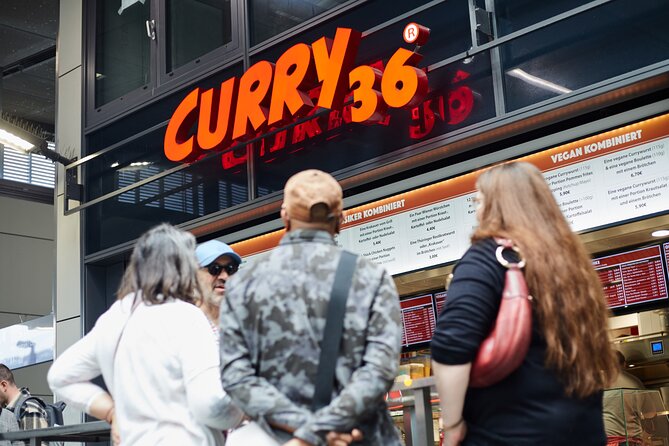
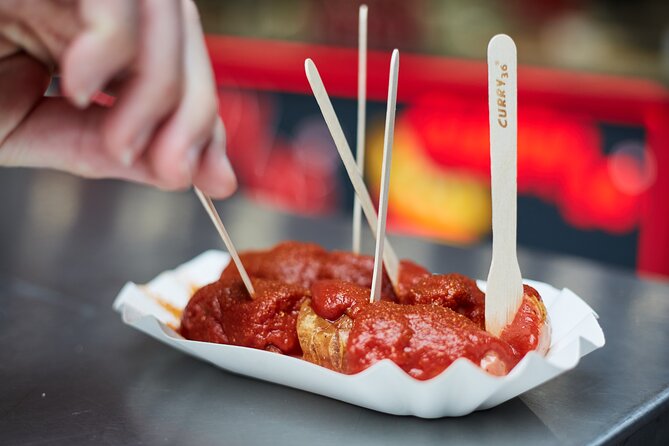
The currywurst stop takes place near Warschauer Strasse, reportedly at a train station, with craft beer included. That setting is important. Currywurst is often treated as a landmark dish, but it is at its most convincing as quick food eaten during ordinary city life.
You learn how the dish was created and why it became such an enduring Berlin favorite. The tasting itself lasts around 15 minutes. It is short, casual, and focused on the food’s place in local culture.
I would keep your expectations realistic. Several people praised the selection of food, but one person specifically noted that currywurst was not a personal favorite. The dish is saucy, filling, and distinctive, but taste is subjective. If you already know you dislike sausage or curry sauce, this stop may be less exciting than the döner, tacos, or mezze.
Still, it is an important inclusion. A tour about Berlin’s food identity would feel incomplete without currywurst, and eating it at a station gives you a more local context than sitting in a formal restaurant.
Schnitzel burger, Berliner Pilsner, and the end of East Berlin
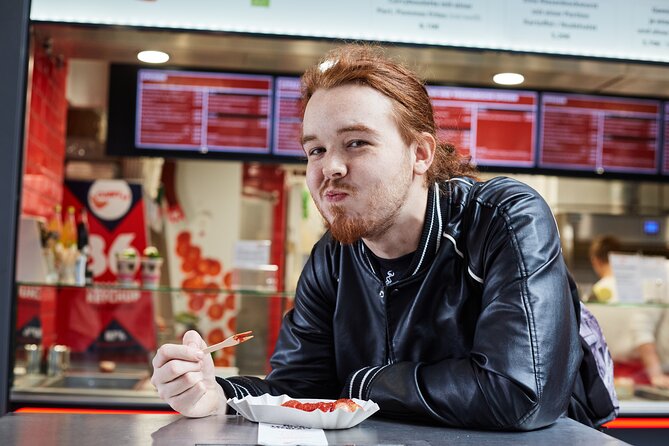
The next stop combines a schnitzel burger with Berliner Pilsner at a small schnitzel burger restaurant and club. The meal is served in a compact setting, and the conversation turns toward daily life in East Berlin near the end of the German Democratic Republic.
This is where the food route connects most directly to political history. You discuss the conditions that led to the fall of the Berlin Wall and how life changed around that period. The stop lasts about 20 minutes, so you get a concise account rather than a full lecture on twentieth-century Germany.
That balance suits the tour. You do not spend three and a half hours indoors listening to dates. You hear history while eating, then continue walking through places where the past remains visible. Guides including Benjamin and Clara have been praised for making complex history easy to follow and for relating it to everyday life.
The schnitzel burger also keeps the tone informal. It is not a formal historical reenactment. It is a modern Berlin food stop with a conversation about a city that has changed dramatically within living memory.
East Side Gallery and the Berlin Wall
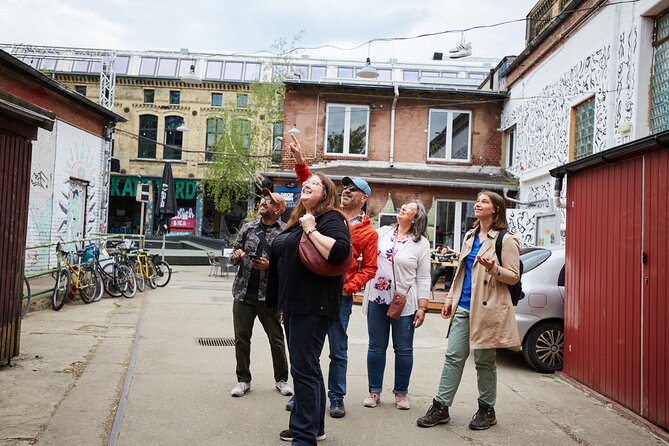
The route ends at the East Side Gallery on Mühlenstrasse 78, where a long surviving section of the Berlin Wall is covered with murals. The open-air gallery stretches for more than 1.3 miles, though the tour gives you roughly 10 minutes at the site.
That is enough for a short introduction and a look at the wall art, but not enough for a detailed walk along the entire gallery. If the murals are a high priority for you, return on your own after the tour and allow extra time.
Ending here gives the experience a clear shape. You begin with neighborhood food and stories of migration, then move through former industrial and East German spaces before finishing at one of Berlin’s best-known symbols of division and change.
Syrian mezze and the newer Berlin
The Aleppo Supper Club offers Syrian and Levantine food, including a traditional mezze dish. This stop adds another layer to the tour’s main idea: Berlin’s food culture keeps changing as new communities arrive and establish roots.
Mezze works well as a shared tasting because it lets you sample several textures and flavors in a relaxed setting. The stop is listed at about 20 minutes. It is not simply a final snack, but part of the explanation of how Syrian cuisine has become part of contemporary Berlin.
The listed route also refers to a Turkish sweet treat and a visit to one of the city’s remaining squat houses, a place connected with political and educational events and live concerts. Because offerings and stops can vary, you should treat these as possible additions rather than guaranteed components of every departure.
The guide matters more than the script
The food is only half the experience. The guide sets the pace, explains the historical links, handles dietary questions, and makes the transitions between stops feel natural.
Clara is repeatedly described as funny, engaged, and well informed about East Berlin and its food cultures. Jed is praised for teaching both the history of Berlin and the background of the dishes. Lily, Eden, Laura, and Benjamin also receive strong praise for warmth, organization, humor, and clear storytelling.
That range of guide names tells you something useful: the experience is not dependent on one personality, but your exact tone may vary by departure. Some guides may focus more on political history, while others may bring more attention to food, migration, music, markets, or neighborhood life.
You also receive insider tips about food and the city. These can help you decide where to eat later in your stay, especially if you want places beyond the usual central Berlin sights.
Price, pace, and practical value
At $107.68 per person, this is not a cheap snack walk. It becomes better value when you count the number of included tastings, the craft beer, the guide, and the three and a half hours of neighborhood history.
You are not paying only for food. You are paying for a route that brings together several cuisines, East Berlin history, street art, converted industrial sites, and places you might not find on your own. The small group limit also adds value because the tour can function as both a food tasting and a personal orientation to the area.
The pace is leisurely, but you should still expect to walk between stops. The route is near public transportation, and it starts at Haroun and ends at the East Side Gallery, so you will not finish where you began. Plan your onward journey from Mühlenstrasse rather than assuming a return to the meeting point.
Come with an empty stomach. The food can add up to a substantial meal, and the best way to enjoy the route is to avoid a large breakfast beforehand. Children under four may join free, but their food is not included. Paid tickets with food are available from age four.
Vegetarian and gluten-free requests can be sent by email or added when booking, and the company will try to accommodate them. Severe or life-threatening allergies are a serious limitation because the company cannot take responsibility for allergies or intolerances connected with the foods served.
Free cancellation is available up to 24 hours before the start time. The tour needs at least two people to operate, and the company will offer a new date, another experience, or a full refund if that minimum is not reached.
Who should book this East Berlin food walk?
I would choose this tour if you want food with context, enjoy small independent places, and have an interest in how migration shaped Berlin. It is also a good first-day activity because the guide gives you neighborhood orientation, food suggestions, and historical background at the same time.
It suits couples, solo visitors, and small groups who like talking with a guide and fellow diners. The 12-person maximum keeps it social without turning it into a large procession.
I would think twice if you want a menu centered on traditional German cooking, dislike walking between stops, or have severe food allergies. The tour is also not the best choice if you want a long, detailed visit to every Berlin Wall mural. The East Side Gallery stop is brief.
Should you book it?
Book it if you want to understand Berlin through the food of its communities, not just through its monuments. The strongest parts are the food and history links, the variety of cuisines, the small group, and the way the route shows ordinary parts of former East Berlin.
The value is solid for a three-and-a-half-hour experience with multiple included tastings and beer. Come hungry, tell the company about dietary needs in advance, and keep your schedule flexible because stops can change. If you do that, this is a smart way to spend an afternoon in Friedrichshain and finish with a clearer sense of how Berlin became the city it is today.
FAQ
How long is the East Berlin Food & History Tour?
The tour lasts approximately 3 hours and 30 minutes.
How much does the tour cost?
The listed price is $107.68 per person.
Where does the tour start?
The meeting point is Haroun at Neue Bahnhofstrasse 28, 10245 Berlin, Germany.
Where does the tour end?
The tour ends at Mühlenstrasse 78, 10243 Berlin, Germany, near the East Side Gallery.
Is food included in the ticket price?
Yes. The listed tastings are included, including dishes such as döner, Vietnamese tacos, currywurst, schnitzel burger, Syrian mezze, and other possible samples.
Are drinks included?
Some drinks are included, including Berliner Kindl light beer and Berliner Pilsner or craft beer at selected stops. Extra drinks are not included.
How many people can join the tour?
The maximum group size is 12 people.
Is the tour offered in English?
Yes. The tour includes a local English-speaking guide.
Can dietary requirements be accommodated?
Vegetarian, gluten-free, and other dietary requests can be sent by email or added at booking, and the company will try to accommodate them. The experience is not suitable for severe or life-threatening food allergies because the company cannot take responsibility for food allergies or intolerances.
Can I cancel for a refund?
You can cancel up to 24 hours before the experience for a full refund. Cancellations or changes made less than 24 hours before the start time are not accepted for a refund.
New food tours we have reviewed in Berlin
- East Meets West: Berlin Food Culture & Street Art★ 5.0 · 157 reviews
- Classic Bites and Culinary Trends Neighborhood Food Tour in Berlin★ 5.0 · 191 reviews
- Private Tour: Daytime Food Tour Trends & Classics★ 5.0 · 24 reviews
- Small-Group Berlin Sightseeing and Food Tour of Prenzlauer Berg and Mitte★ 5.0 · 25 reviews
- Private Berlin Street Food Tour by Bike★ 5.0 · 87 reviews
- The 10 Tastings of Berlin Kreuzberg Private Food Tour With Locals★ 4.5 · 31 reviews
- Berlin Evening Culinary Tour – Award Winning★ 5.0 · 118 reviews
- The Berlin Culinary Experience: A Regional & Cultural Food Tour★ 5.0 · 79 reviews
Historical Tours, compared.
Barcelona: Tapas Walking Tour with Food, Wine, and History
Read our review →
Sevilla Food Tour: Tapas, Wine, History & Traditions
Read our review →
Madrid Tapas & Taverns Small Group Food & History Tour
Read our review →
Barcelona Tapas Walking Tour: Food, Wine & History
Read our review →
Boston Food & History: Pizza, North End & Freedom Trail
Read our review →Browse the lists this tour appears in