
Review · FOOD WALKING TOURS
Osaka Local Foodie Walking Tour in Dotonbori and Shinsekai
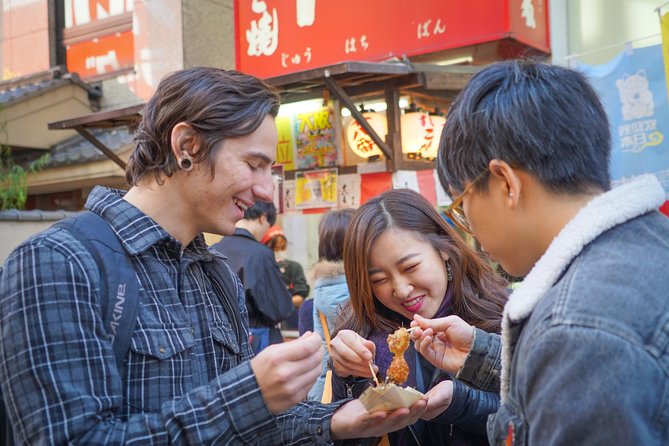
Osaka’s best-known food streets come alive on this three-hour walk, which links old Shinsekai with neon-lit Dotonbori. You’ll eat six kushikatsu skewers, okonomiyaki, takoyaki, and three drinks while passing through narrow lanes, a Shinto shrine, Hozen-ji Temple, and the famous Glico sign. The food is the main event, but the neighborhood orientation matters just as much.
I like the small maximum group of seven, since it gives a guide such as Aika, Yuma, Michiko, or Emi room to answer questions and help with photos. I also like the route’s contrast: Shinsekai feels more old-fashioned and local, while Dotonbori is Osaka’s loud, crowded postcard center. The main caution is value. At $111.42, this is not a bargain if you want many small tastings or serious food research.
Key points at a glance
- Six kushikatsu skewers give you a proper taste of Osaka’s deep-fried street food.
- Okonomiyaki, takoyaki, and three drinks are included, with alcohol and nonalcoholic choices.
- The seven-person limit can make the walk feel personal, and a family of six may effectively have a private outing.
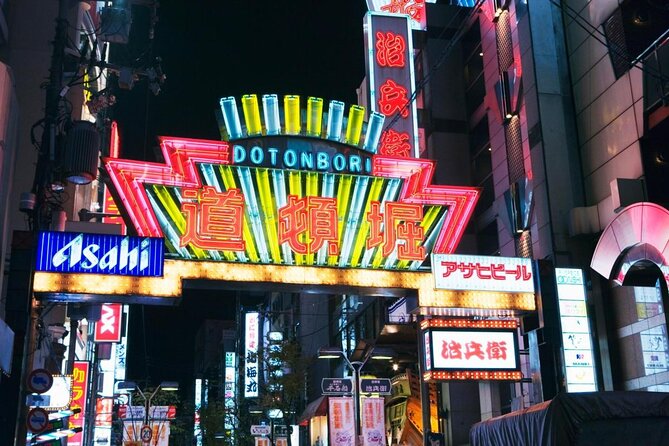
- Shinsekai and Dotonbori offer very different moods, from Tsutenkaku and Jan-Jan Yokocho to the Glico sign.
- Vegetarian requests must be made by the day before, and gluten-free and vegan meals cannot be accommodated.
- Some outings feel more like a neighborhood tour with food than a dedicated food crawl with many restaurant stops.
What you are really buying for $111.42
The price pays for more than the food on the plate. You are buying a guide, a planned route, three drinks, and a gentle introduction to two of Osaka’s most famous areas. You also avoid the small stress of choosing a restaurant, decoding a menu, or guessing how to order at a busy counter.
Still, $111.42 is a serious price for three hours. The included food is substantial, but the selection is focused: six fried skewers, one serving of okonomiyaki, one box of takoyaki, and drinks. This is not a progressive tasting menu with tiny portions at five or six independent shops.
That difference matters. If you want to eat Osaka’s signature dishes while someone explains local customs, the package can make sense. If you already know Dotonbori and feel comfortable ordering food in Japan, you may find it cheaper to visit these areas on your own.
The strongest value comes from the guide. Aika has been praised for connecting food with Osaka life and for suggesting later snack stops. Yuma has been described as warm, clear in English, and good at explaining how dishes are made. Michiko has received praise for combining food, local history, and practical sightseeing. The quality can depend on which guide leads your group, so keep your expectations focused on a well-organized introduction, not a specialist culinary seminar.
More Food Walking Tours in Osaka:
- Kuromon Market Food Walking Tour in Osaka (6 stops, 6 tastes)
★ 5.0 · 550 reviews - Osaka: Kuromon Market Food Walking Tour (6 stops, 6 tastes)
★ 4.6 · 272 reviews - Reykjavik Food Walk – Local Foodie Adventure in Iceland
★ 5.0 · 18,952 reviews
Starting under Tsutenkaku in Shinsekai
The meeting point is outside FamilyMart Japan in Sanno, in Osaka’s Nishinari Ward. This is not the clearest or most central meeting point in the city, so allow extra time to find it. One low rating specifically described the location as hard to reach, and that is useful advice. Do not cut it close.
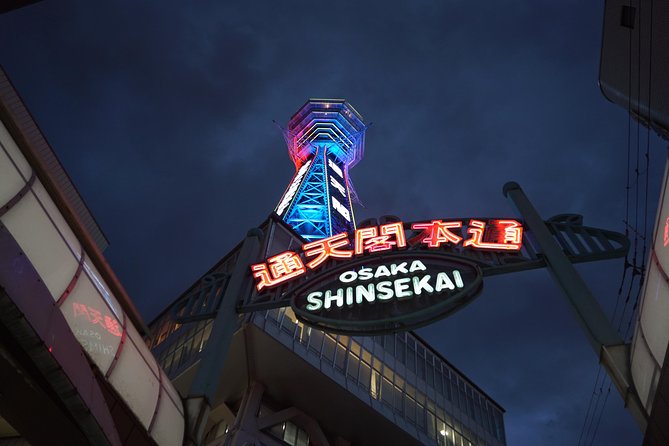
The walk begins around Tsutenkaku, the tower that watches over Shinsekai. This neighborhood has a distinct feel, with old-style shopfronts, local eateries, narrow lanes, and a slightly worn character that differs from polished shopping districts. You get a look at Osaka away from the giant signs and department stores.
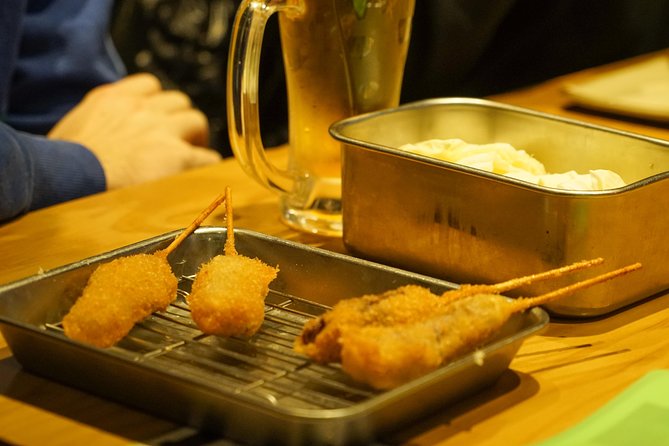
Jan-Jan Yokocho is an early highlight. The alley has a strong connection to Shinsekai’s older food culture and is the setting for the first substantial tasting. Here you receive six kushikatsu skewers, the famous Osaka dish of meat and vegetables coated, skewered, and deep-fried.
Kushikatsu is simple food, but it tells you a lot about the neighborhood. It is hot, crisp, filling, and best eaten right away. The portions mean you will not leave hungry, but they also take up room that could otherwise go to more dishes later. If you want a tour with many tiny bites, this first stop may feel generous rather than varied.
Three drinks are included during the experience, and both alcoholic and nonalcoholic options are available. That is useful for a relaxed evening outing, though some people do not want two drinks at the first venue. You can ask your guide how the drinks are arranged on your particular departure.
Walking through old Shinsekai
After the kushikatsu, you continue through Shinsekai Market toward Tsutenkaku and a Billiken statue. Billiken is a familiar symbol in Shinsekai, and the stop gives the guide a chance to explain the neighborhood’s older character and local customs.
The route also includes a museum-like alley designed to show Osaka as it appeared more than 80 years ago. This is one of the more unusual parts of the outing because it shifts the focus from eating to place. You are not simply moving between restaurants. You are seeing a district where older Osaka remains visible in the streetscape.
The walking pace deserves attention. One person found the guide moved too quickly, while another found the route too slow and wanted to sit down sooner. That sounds contradictory, but it points to a real issue: the best pace depends on your group, guide, weather, and appetite.
If you arrive hungry, you may wish the first food stop came sooner. If you want explanations and photographs, you may appreciate the extra walking. Tell your guide early if you need a slower pace or a brief pause. The tour is only about three hours, so the route cannot stop for long at every corner.
From Shinsekai to Dotonbori
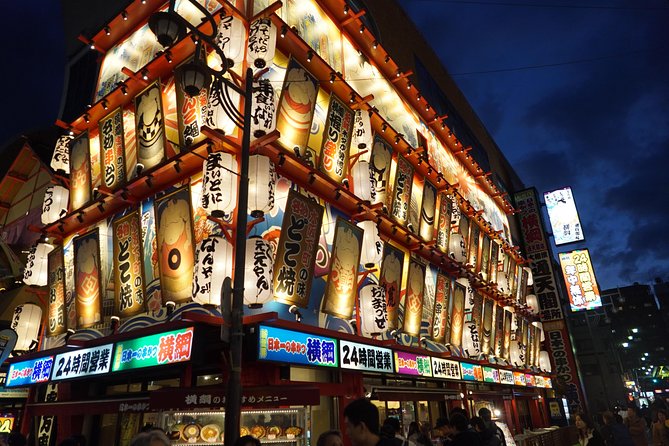
The exact middle section varies somewhat between daytime and nighttime departures. During the day, the route may include Dōgu-ya-suji, the cooking-tool shopping street, including a knife shop known as Hōchō-ya. At night, the guide may explain the Dōgu-ya-suji area near Namba Grand Kagetsu before taking you shopping nearby.
This is a useful addition for anyone interested in Japanese kitchen tools or souvenirs. It also helps explain why Osaka has such a strong food identity. Knives, pans, signs, plastic food models, and restaurant supplies are part of the working life behind the dishes you are eating.
Do not expect a long shopping session. The stop is about 15 minutes, so it is mainly an introduction and a chance to look around. If you hope to buy a Japanese knife, you will need to return later with more time for careful comparison.
More food tours in Osaka:
- Osaka: Shinsekai Food Tour with 13-15 Dishes at 5 Eateries
★ 4.8 · 2,204 reviews - Osaka Food Tour: 13 Dishes at 5 Local Eateries
★ 5.0 · 2,149 reviews - Hungry Osaka Street Food Tour:15 Tastings & 3 Drinks with a Local
★ 5.0 · 1,727 reviews - Sushi Making Osaka Roll and Authentic Japanese Sushi Class
★ 5.0 · 1,220 reviews
Hozen-ji Temple and Ukiyo Alley
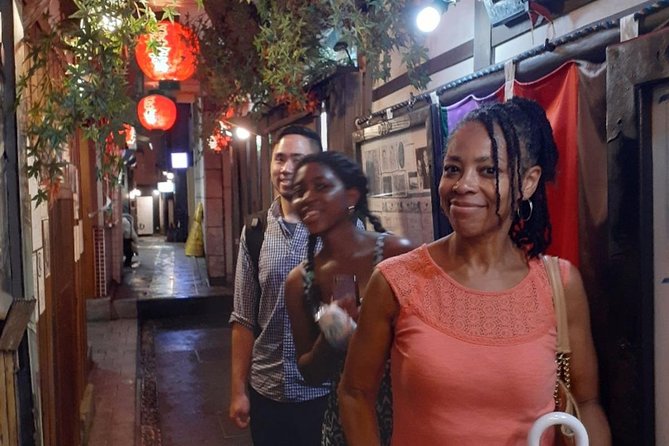
Hozen-ji Temple offers a quiet break from the noise around Namba and Dotonbori. The temple is small, and the nearby Ukiyo-koji, or Ukiyo Alley, adds a narrow, atmospheric passage to the route.
The guide may explain how the temple fits into local life and may help with photographs. Several guides have been praised for taking photos and for pointing out shrines and temples along the way. That small service can be especially helpful when you are traveling as a couple or family and want everyone in the picture.
The timing can affect this stop. At night, the temple area may be dark, which makes it atmospheric but less useful for examining details. If temple architecture is a priority, visit again in daylight. On the food walk, treat it as a brief cultural pause rather than a major temple visit.
You may also receive a small snack here or nearby, such as takoyaki or sweets, for about ¥500. The supplied food plan includes one box of takoyaki, but the precise order and venue can vary. Some outings have reached the takoyaki after the group was already full from earlier food. If you want to enjoy it properly, pace yourself with the kushikatsu and okonomiyaki.
Dotonbori’s neon and the Glico sign
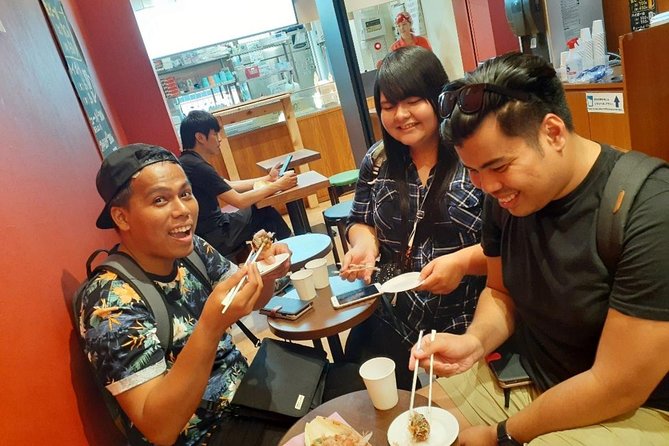
The Glico Running Man sign is the required photo stop. You will have time to take pictures beside the canal and the famous sign before the walk continues or ends.
Dotonbori is the most recognizable part of the route, but it is also the least secret. The giant signs, food displays, and crowds are fun for a first visit, yet this is Osaka’s main tourist stage. The tour gives you a sensible way to get oriented, but it does not turn Dotonbori into an undiscovered corner of the city.
That is not necessarily a weakness. First-time visitors often need to see the famous places before branching out. A guide can show you where the main streets lead, point out food districts, and suggest what to try later. Aika, for example, has been praised for offering ideas for snacks to take home and places to visit after the walk.
Okonomiyaki at Doguyasuji
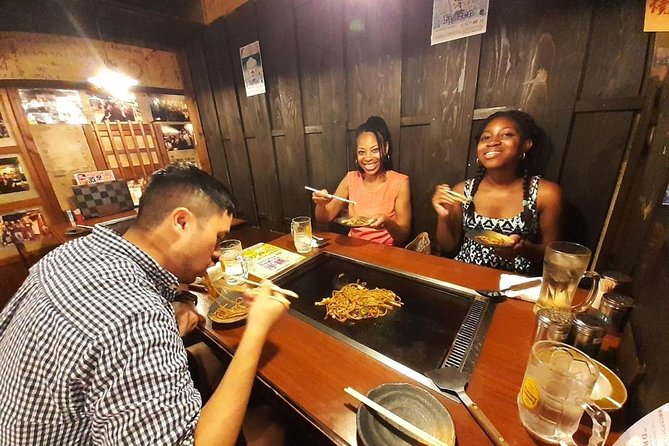
The final major food stop is Osaka-style okonomiyaki, the savory pancake made with batter and toppings. The name combines okonomi, meaning as you like, and yaki, meaning grilled. Cabbage is central, and the finished dish is usually topped with sauce and other additions.
The included portion is one piece. At some venues, you may grill your own okonomiyaki, which adds a hands-on part to the meal. That can be a highlight, especially if you have never prepared it yourself.
This is also where expectations vary. Some people consider the okonomiyaki the best dish of the outing. Others have found the venue more tourist-oriented than the kushikatsu stop. The dish itself can be excellent, but you should not assume every restaurant on the route is a tiny local shop unknown to visitors.
The order of the food matters. Okonomiyaki is filling, and eating it before takoyaki may leave you too full for the final dish. You can tell your guide if you are worried about portion timing. The tour is designed as a group experience, so the exact sequence may not always match your ideal food crawl.
Food variety, dietary limits, and drinks
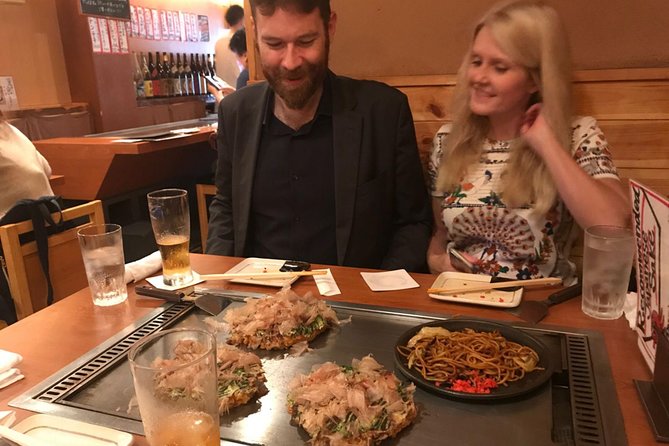
The menu gives you Osaka’s major comfort foods, but it leans heavily toward fried and filling dishes. Kushikatsu and takoyaki are both cooked in oil, while okonomiyaki is a substantial grilled meal. If you prefer lighter food, seafood variety, sweets, or small portions at many different stalls, this may not feel like a full food exploration.
Gluten-free and vegan diets cannot be accommodated. Vegetarian food is possible only if you select that option when booking or request it by the day before. Even then, the kushikatsu restaurant uses dashi made with pork broth, so tell the operator in advance if you cannot have dashi.
Allergy requests must also be made at least one day before the tour. Allergy-free meals and substitutions cannot be guaranteed because the food is prepared in kitchens the operator does not control. This is a significant point, not fine print to ignore.
Smoking may be allowed at some venues, and the group may not be able to change restaurants if that applies. Ask about this before booking if smoke is a serious concern.
Guides, group size, and the human factor
The maximum group size is seven, which is a real advantage in narrow lanes and crowded evening streets. A family of six may end up with what feels like a private tour, while a couple could share the experience with only a few others.
The guides are a major part of the experience. Aika has been praised for lively explanations, local suggestions, food knowledge, and taking photographs. Yuma has been described as friendly, helpful, and good at explaining dishes. Michiko has been praised for linking restaurants and everyday customs. Emi has made a strong impression by tying food choices to ordinary Osaka life.
The experience is not perfectly uniform. Some guides offer plenty of historical and cultural explanation. Others may answer questions well but provide less narration while walking. If you want a running commentary from meeting point to final stop, say so. Ask questions rather than waiting silently, especially during the walks between venues.
The guide may also walk faster than you expect. Wear comfortable shoes, keep the group in sight, and arrive early. Late arrivals cannot join, reschedule, or receive a refund.
Weather, transport, and practical planning
The tour runs for about three hours and finishes at the Glico sign in Dotonbori. Transportation is not included, apart from the note that ¥190 is excluded, so budget for local transit to the starting point and any required movement during the outing.
Osaka’s weather can be demanding. Summer temperatures may reach 40°C, while winter lows can fall to -5°C. Wear light clothing and carry water in hot weather. In winter, bring enough layers for standing outside and walking through open streets.
All ages can join, and most people can participate. The route includes walking, standing, crowded streets, narrow alleys, and restaurant stops. The operator does not present it as a fully accessible tour, so ask before booking if you have mobility needs that make these conditions difficult.
Free cancellation is available up to 24 hours before the start time. Changes or cancellations inside that window are not accepted for a refund.
Who should book this Osaka food walk?
I would recommend it most to first-time visitors who want a ready-made introduction to Shinsekai and Dotonbori. You get the major dishes, two very different neighborhoods, a temple, a shrine area, shopping streets, and a famous photo stop without having to plan the evening yourself.
It also suits families and small groups who value a guide’s help with ordering, photos, and local context. Repeat visitors may enjoy it if they have not spent time in Shinsekai or want a social evening with classic Osaka food.
I would be more cautious if you call yourself a serious food enthusiast. The route includes good-known dishes, but it does not promise a long series of specialist venues. You may find the food filling but not especially varied, and some restaurants may feel geared toward visitors rather than devoted local regulars.
Vegetarians can consider it only after making the right request in advance. Vegans, people who need gluten-free food, and anyone with serious allergies should choose another activity.
Should you book it?
Book this tour if you want classic Osaka food plus neighborhood orientation in one compact outing. The strongest parts are the small group, the range of guides, the contrast between Shinsekai and Dotonbori, and the practical help you receive during a first night in the city.
Skip it if your top priority is maximum food variety, tiny portions at many independent stalls, or a low-cost meal. At $111.42, the tour earns its price through guidance and convenience, not through the number of dishes alone. For the right visitor, it is an easy and sociable introduction to Osaka. For a dedicated food hunter, a more specialized food crawl may offer better value.
FAQ
How long does the Osaka food tour last?
The experience lasts approximately three hours.
Where does the tour start?
It starts at FamilyMart Japan, 1-17 Sanno, Nishinari Ward, Osaka, 557-0001.
Where does the tour end?
The tour ends at the Glico Sign in Dotonbori, at 1-10-3 Dotonbori, Chuo Ward, Osaka, 542-0071.
How many people can join the tour?
The maximum group size is seven people.
What food is included?
The food includes six kushikatsu skewers, one piece of okonomiyaki, and one box of takoyaki.
Are drinks included?
Yes. Three drinks are included, and both alcoholic and nonalcoholic options are available.
Can vegetarians join?
Vegetarians can join if they select the vegetarian option when booking or request it no later than the day before. The kushikatsu restaurant uses pork-broth dashi, so mention this if you cannot consume dashi.
Can the tour accommodate vegan or gluten-free diets?
No. Vegan and gluten-free diets cannot be accommodated on this tour.
What happens if I arrive late?
The tour starts on time. If you arrive late and miss the group, you cannot join later, reschedule, or receive a refund.
New food tours we have reviewed in Osaka
- Hidden Osaka – Yukaku Red Light Tour & Culinary Adventure★ 4.8 · 96 reviews
- Eat Like a Local in Osaka – Private Custom Street Food Tour★ 4.3 · 33 reviews
- Osaka: Sushi Class in Dotonbori★ 4.9 · 160 reviews
- Osaka: Sushi Making in Spacious Studio (SAME-DAY OK!)★ 5.0 · 75 reviews
- Osaka: Local Foodie Tour in Dotonbori and Shinsekai★ 4.7 · 95 reviews
- Osaka: Kuromon Market Food Walking Tour (6 stops, 6 tastes)★ 4.6 · 272 reviews
- Osaka: Roll and Authentic Sushi Making Class in Dotonbori★ 4.9 · 239 reviews
- Osaka: 2-Hour Local Street Food Tour – Dotonbori & Namba★ 4.6 · 95 reviews
Food Walking Tours, compared.
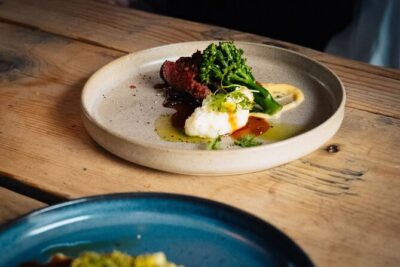
Reykjavik Food Walk – Local Foodie Adventure in Iceland
Read our review →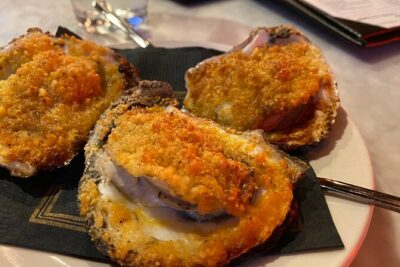
New Orleans Food Walking Tour of the French Quarter with Small-Group Option
Read our review →
Naples: Street Food Walking Tour with Local Guide
Read our review →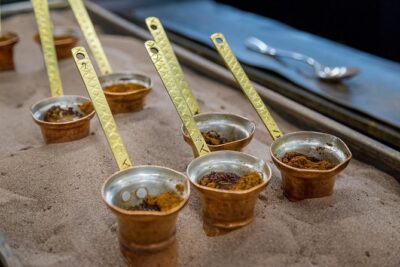
Savannah First Squares Culinary & Cultural Walking Food Tour
Read our review →
Rome: Guided Food Walking Tour with Wine in Trastevere
Read our review →
Rome: Trastevere & Campo de Fiori Street Food Walking Tour
Read our review →Browse the lists this tour appears in